The Political Economy of Geographic Healthcare Inequity
- Aug 12, 2026
- 177 views
Introduction
The geographical maldistribution of the medical workforce is a structural failure of modern society, driven by unchecked market forces in the healthcare industry, accentuated by regulatory bottlenecks, and a systemic underinvestment in the rural infrastructure required for healthcare delivery.1-3 After synthesizing recent reports on the shortage of doctors and nurses in rural United States, this editorial summarizes critical evidence on market consolidation,4,5 pediatric6,7 and maternity care unit closures,8,9 systemic limitations of Graduate Medical Education (GME) allocation,10 and the role of telemedicine in rural physician retention.
Health Workforce Maldistribution
Only 9-11% of US physicians practice in rural areas, completely inadequate for the lives covered in rural communities.13 The persistent deficit of physicians in rural communities is not an accident of geography, it stems from the direct consequence of structural economic failures and political choices.14 In profit-hungry, marketdriven healthcare systems, capital allocation inevitably flows toward paths that maximize financial returns, creating a severe chasm between thriving urban centers and neglected rural geographies.1
While medical schools have graduated record numbers of clinicians globally, the lack of strong regulatory frameworks ensures that these professionals remain concentrated not only in the most affluent metropolitan locations but also gravitate to financially lucrative specialties. Let us examine how commercial and institutional factors have interacted to create a crisis of rural medical access, highlighting structural flaws, and exploring potential solutions.
The Profit-Driven Neglect of Underserved CommunitiesIn the United States, healthcare delivery operates under the constraints of late-stage capitalism, where shareholder value and corporate returns take priority over equitable public health distribution and patient outcomes. Market dynamics have undermined the viability of rural clinics and community hospitals through several distinct mechanisms.
Large-scale hospital consolidations have proceeded unchecked across many regional markets, directed towards limiting competition and raising prices. These market forces have driven the total assets held by US hospitals from $750 billion in 2000 to $1.6 trillion in 2019. The systematic acquisition of physician practices by for-profit entities and private equity firms has accelerated in the last decade, now estimated at almost two-thirds of all physician practices. These strategies had left only 18% of US doctors practicing in physician-owned clinics by the start of 2026, consequently eroding both physician autonomy and patient-centered care. Economic analyses show that corporate mergers predictably drive up baseline healthcare costs rather than generating efficiencies, partly because of the huge power differential between individual customers and their corporate providers. Capital allocations have consistently shifted away from unprofitable services (like maternal and pediatric care) and out of low-margin rural sectors to fund highly profitable urban facilities and services (Figure 1).
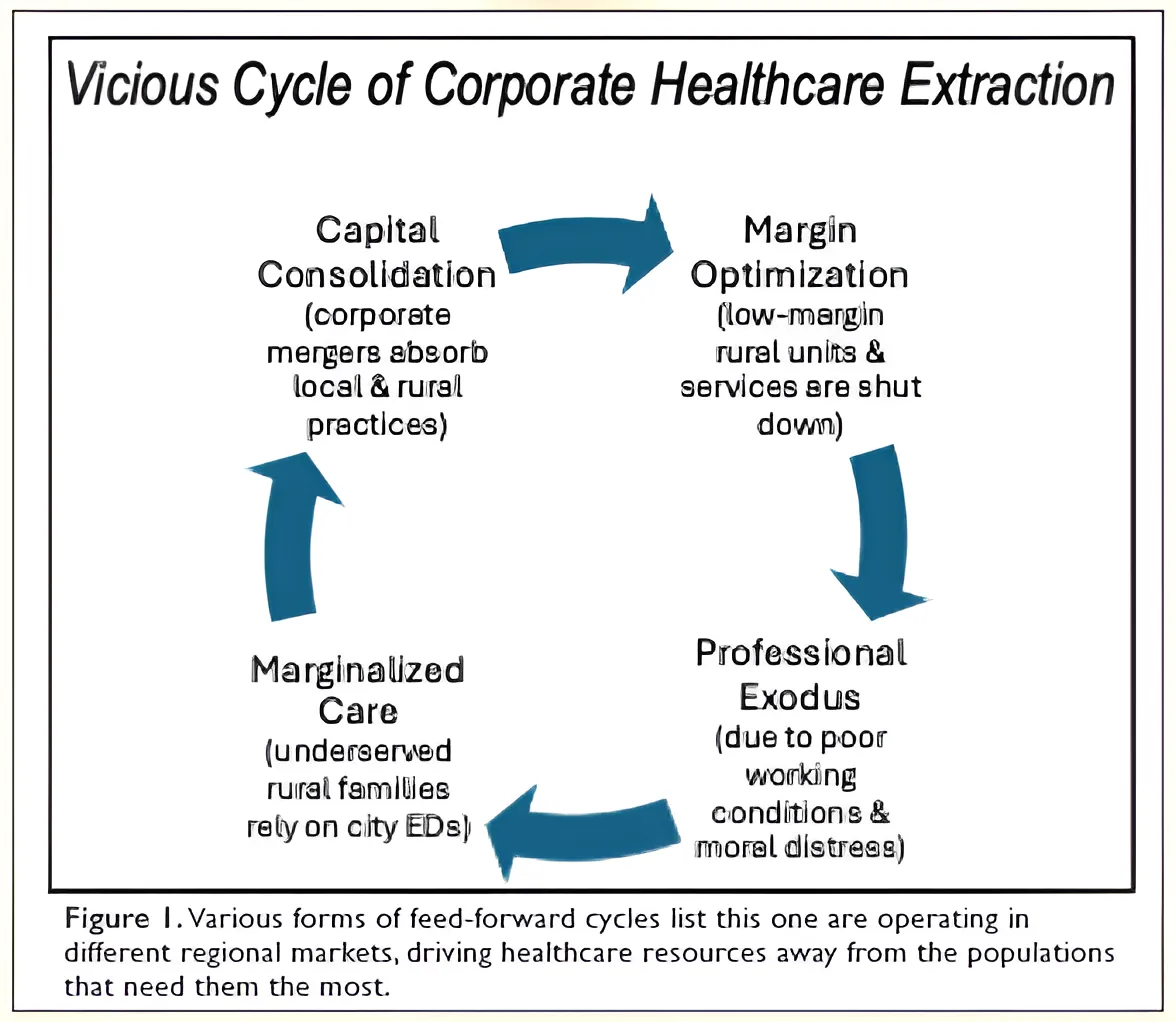
Financial extraction from healthcare markets directly and indirectly triggers a cascade of detrimental effects at multiple levels, in overt or insidious ways, often leading to systemic societal harm over time. Multi- hospital conglomerates, owning numerous physician practices continue to build massive balance sheets while cutting costs and essential local services. As market share access and referral patterns shift, nonprofit hospitals and academic institutions are forced to close down their medical services in low- income zip codes and open lucrative sites in wealthy suburbs. Excessive executive compensation and high administrative overheads pull vital resources out of frontline clinical delivery.21 Aggressive collection agencies and predatory pricing practices have locked up over 40%40% of American adults into deep medical debt, causing moral injury to local clinicians.22,23
2. GME Allocation Failures and Pipeline Bottlenecks
The structural foundation of the U.S. physician shortage is rooted in statutory restrictions on graduate training pipelines. Medical student enrollment in the US has increased by 60%60% over the past two decades, with a sustained majority of women (57%)(57%) entering medical school,24 while the representation of minorities and rural students has lagged behind.25 This gap widens further in residency and fellowship training because of the lack of investment in postgraduate training infrastructure and jobs, creating the strongest bottleneck in the physician supply pipeline. Two main factors sustaining this bottleneck include statutory constraints and regulatory inequities in job distribution.
Legislation such as the Balanced Budget Act of 1997 imposed a rigid cap on Medicare- funded residency positions, restraining the annual growth in GME training pathways below 3%3% , despite a growing and aging population as well as a larger pool of medical graduates. Hospitals and academic institutions were forced to absorb the direct costs of residency slots onto their own bottom lines, directly impacting their profit margins. Several corporate hospitals have eliminated or significantly reduced their financial support for GME training. Climbing average medical educational debt (( 200,000 to 250,000)250,000) also drives medical graduates away from the lower- paying rural primary care into urban sub- specialties.26
Regulatory inequities in slot distribution have further worsened the rural healthcare crisis. In 2020, Medicare dedicated 16.2billiontoGMEfunding,yetamere2billiontoGMEfunding,yetamere2 of the US population living in underserved rural communities.
3. The Collapse of Rural Inpatient Care
The ongoing physician shortage creates a dangerous loop of health infrastructure decay. As doctors leave rural practices, the local clinics and small hospitals become unsafe or financially non- viable, leading to closures that prevent any future physician recruitment. High fixed baseline operating costs due to regulatory requirements make maintaining standalone, low- volume units unsustainable. Extreme difficulties in retaining nursing and multidisciplinary ancillary teams makes it even harder to keep these rural units open.
-
Telemedicine as a Structural MitigantDigital health technology and telemedicine were considered as potential solutions, particularly after the COVID-19 pandemic, to fill the geographic gaps created by rural physician shortages. 30,3130,31 Despite these predictions, the academic literature highlights that virtual care models may function as a double- edged sword for retaining physicians in rural areas, 12 or for sustaining access to primary or secondary healthcare for rural families and communities. Emerging advantages and disadvantages are summarized in Table 1 below.
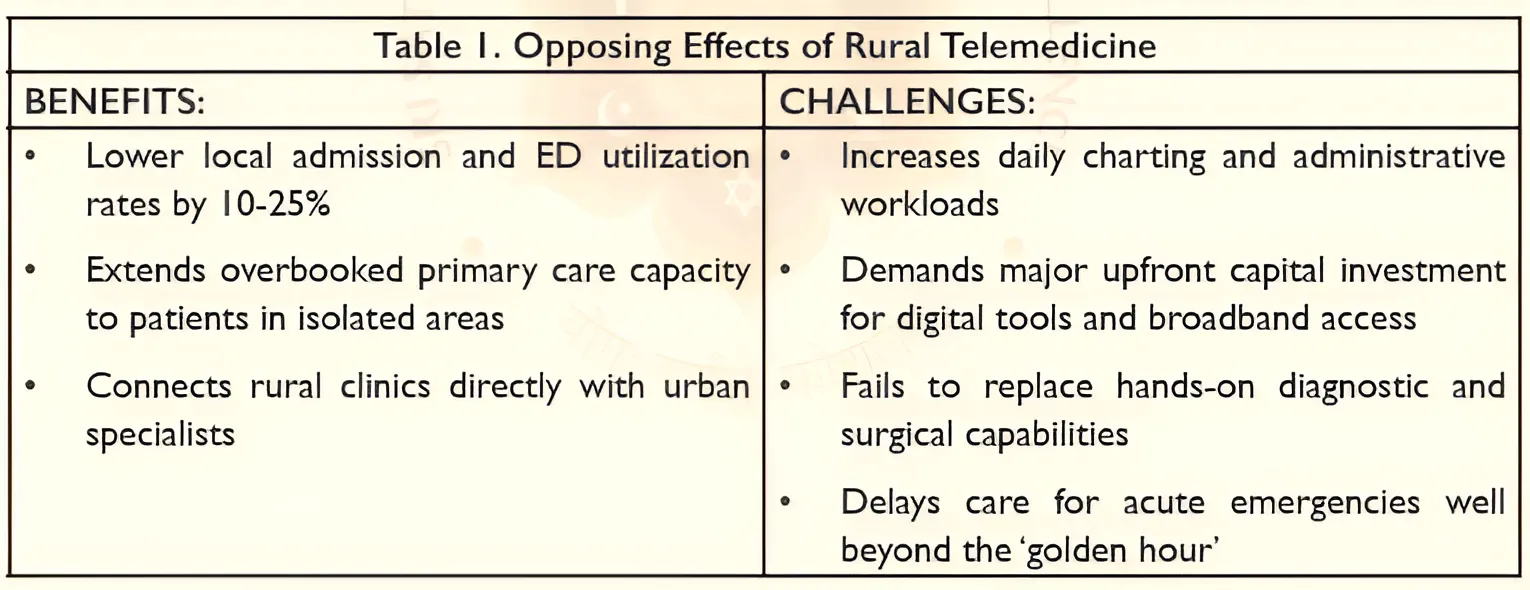
Many people living in rural communities are less comfortable with technology, and they particularly feel the lack of physician warmth, gentle touch, and genuine concern during telehealth consultations. Rural folks may lack the appropriate equipment (computer, camera, smartphone, broadband service) and the motivation to access healthcare remotely, leading to significant differences in the use of telemedicine between urban and rural patients across younger and older age groups. 32,3332,33 Rural families are also reluctant to allow healthcare providers to view their homes and living conditions because of privacy needs. Though telemedicine may provide a reasonable solution to access urban specialty care for rural communities, but it cannot adequately replace the loss of local primary care or emergency services. 3434
Albeit limited, telemedicine does have an important role in rural healthcare delivery. Virtual consult networks do expand the reach of rural doctors, allowing them to care for isolated populations with limited mobility. For example, a telemedicine consultation network in rural California successfully
lowered local hospital admissions and emergency department utilization. Remote support options can also ease the clinical burden on overbooked primary care physicians by triaging non- acute cases. Telemedicine integration can also help rural community emergency departments to maintain pediatric readiness without requiring permanent on- site specialists.
However, virtual tools cannot replace on- the- ground diagnostic infrastructure, hands- on clinical intuition, or local surgical capabilities. Small rural hospitals frequently face severe funding and reimbursement challenges when trying to set up and maintain advanced telehealth systems. Relying heavily on digital care can also worsen administrative burnout if it adds to data entry burdens rather than reducing paperwork. In summary, telemedicine works best as a retention tool when it connects rural doctors to urban specialist networks, making them feel less professionally isolated.
5. International Parallels: Rural healthcare in India
The structural challenges seen in the United States match the inequity in healthcare workforce distribution in India, though the economic contexts differ. India produces a large volume of medical graduates every year, yet it faces a deep urban- rural chasm driven by the demographics of medical graduates and their training design.
Approximately 80%80% of India's MBBS graduates settle in urban cities, while only 20%20% practice in rural areas. This maldistribution leaves a massive 65%65% of the population medically underserved in rural districts. Rural public health postings are widely viewed by medical interns as a form of "punishment" because of their distance from urban amenities and social networks. Staffing vacancies persist in rural Primary Health Centres (PHCs), which often lack reliable electricity, clean water, safe housing, or good local schools for physician families. The traditional medical curriculum focuses heavily on high- tech tertiary care, preparing students more for careers in developed countries rather than for practicing in rural settings.
The National Eligibility cum Entrance Test (NEET) is India's sole national- level entrance examination for undergraduate medical education. It is mandatory for securing a seat in MBBS, BDS, AYUSH, and Veterinary courses across all government and private institutions. The NEET exam poses as a major educational barrier, because less than 5%5% of top scorers come from rural backgrounds. Illegal capitation practices and exorbitant tuition fees at private medical colleges force graduates to seek high- paying urban corporate positions to pay off their educational debts. Furthermore, exclusive use of the English- language in medical school training further blocks qualified rural youth receiving instruction in regional languages from rural government schools, before applying for the NEET exam.
For the MBBS graduates of government medical colleges, mandatory rural service for 1- 2 years was traditionally enforced by some States, through compulsory rural service bonds. These coercive mandates often did not work as intended because medical graduates from middle- class or wealthy families could simply paid off the financial penalty to avoid rural service postings. Some states, including Maharashtra, Kerala, and Andhra Pradesh have scrapped these service bonds, whereas other states like Karnataka have relaxed the enforcement of their mandatory one- year social responsibility service bond. National institutions like AIIMS and JIPMER and private medical colleges did not implement mandatory post- MBBS service bonds.
Similar factors apply to residency training or postgraduate medical education in India. Most seats are available only in urban centres and these programs charge even higher fees for admission and tuition than the MBBS courses. The pipeline of MBBS graduates from rural areas is already restricted, but it faces further drastic reductions in their entry into the highly competitive postgraduate programs. Innovative and effective approaches must be explored to address these glaring inequities, and to bridge the widening gaps in rural healthcare workforce distribution.
-
Pathways of Promise
Conceived and built during the COVID-19 pandemic and inaugurated in March 2023, the Sri Madhusudan Sai Institute of Medical Sciences and Research (SMSIMSR) has introduced a radically new alternative, creating free-of-charge training pipelines for both under-graduate and postgraduate medical students. This unique and innovative program provides completely free tuition, boarding, books, materials, clothing, toiletries, and other amenities to rural youth in exchange for a binding commitment to serve in rural healthcare facilities for a duration equal to their years of subsidized study. All teaching and training courses are conducted in state-of-the-art, advanced facilities within a values-based, residential and holistic educational system, and endowed with deep spiritual understandings. This unprecedented approach seeks to build a community-specific healthcare workforce by training medical professionals within a rural milieu, eliminating student debt, and bypassing the well-beaten paths to urban migration. In addition to nurturing clinical talent, imparting knowledge and skills, this unique institute is building character and integrity among medical professionals, creating an inspired healthcare workforce dedicated to building their careers in rural medical practices.
Generating a sustainable rural healthcare workforce, however, will require much greater investment than the efforts of one institution. International healthcare systems must shift from short- term recruitment bonuses to systemic structural reforms. All countries dealing with the rural healthcare crisis must adopt models like SMSIMSR that actively recruit, support, and train rural youth within rural clinical environments to foster a long- term commitment to community service. The US must first overhaul GME funding models by un- capping residency slots and legally mandating that a significant percentage of funding be allocated to rural underserved areas and regional primary care programs. Legislators and administrators at all levels must also work hard to protect the smaller regional and rural hospitals from corporate exploitation, stabilize Medicaid and public health insurance reimbursements, upgrade clinical utilities in underserved areas, and provide full student loan forgiveness that is annually tied to physicians, nurses, or other healthcare providers remaining and exclusively practicing in rural geographies. Policy reform, political will, and innovative models like the SMSIMSR have the potential to bridge rural- urban disparities in healthcare delivery, edging the world closer towards achieving the UN Sustainable Development Goals (SDGs), namely, SDG#3 and SDG#10.38
Supplementary Materials: None.
Author Contributions: N/A.
Funding: None.
Institutional Review Board Statement: N/A.
Informed Consent Statement: N/A.
Data Availability Statement: N/A.
Acknowledgments: The author is deeply grateful to Sadguru Sri Madhusudan Sai for his tireless efforts to uplift the downtrodden masses and to serve the poorest of the poor, inspiring millions to follow his example of selfless love and service. His One World One Family Global Humanitarian Mission promises to provide completely free- of- charge nutrition, education, and healthcare to each and every human being on this planet, regardless of caste, color, creed, religion, national origin, and any other identifying features.
Conflicts of Interest: None.
-
Berwick DM. Salve Lucrum: The Existential Threat of Greed in US Health Care. JAMA 2023;329(8):629-630. DOI: 10.1001/jama.2023.0846.2. Arakelyan M, Freyleue SD, Schaefer AP, et al. Rural-urban disparities in health care delivery for children with medical complexity and moderating effects of payer, disability, and community poverty. J Rural Health 2024;40(2):326-337. DOI: 10.1111/jrh.12827.3. Arakelyan M, Schaefer AP, Freyleue SD, et al. Rural-urban disparities in primary care and geographic continuity of care for children with medical complexity. J Rural Health 2026;42(1):e70122. DOI: 10.1111/jrh.70122.4. Graff J, Ayub M, Prabakaran P, Keelan B, Cramer JD. Association of Hospital Consolidation with Cancer Outcomes. Inquiry 2025;62:469580251314954. DOI: 10.1177/00469580251314954.5. Salik I. A call to arms: private equity and the US healthcare system. Br J Anaesth 2024;132(6):1340-1341. DOI: 10.1016/j.bja.2024.02.034.6. Cushing AM, Bucholz EM, Chien AT, Rauch DA, Michelson KA. Availability of Pediatric Inpatient Services in the United States. Pediatrics 2021;148(1). DOI: 10.1542/peds.2020-041723.7. McDaniel CE, Hall M, Berry JG. Hospitalization Patterns for Rural-Residing Children from 2002 to 2017. Acad Pediatr 2025;25(1):102554. DOI: 10.1016/j.acap.2024.07.021.8. Anders AP, Cammack SE. Maternity Care Deserts: Disparities in Maternal and Infant Access to Care and Potential Solutions. Noereviews 2026;27(5):e287-e295. DOI: 10.1542/neo.27-5-011.9. Dissanayake MV, Jackson JW, Urrutia RP, Martin CL, Funk MJ, Wood ME. Effects of hospital and obstetric unit closures on postpartum acute care across county racial composition in rural North Carolina. J Rural Health 2026;42(1):e70114. DOI: 10.1111/jrh.70114.10. Rains J, Holmes GM, Pathak S, Hawes EM. The Distribution of Additional Residency Slots to Rural and Underserved Areas. JAMA 2023;330(10):968-969. DOI: 10.1001/jama.2023.14452.11. Ford C, Orr E, Hudson H, et al. Provider-to-provider telehealth use for obstetric services by rural practitioners: A scoping review. J Rural Health 2026;42(1):e70118. DOI: 10.1111/jrh.70118.12. Potter AJ, Mueller KJ, Mackinney AC, Ward MM. Effect of tele-emergency services on recruitment and retention of US rural physicians. Rural Remote Health 2014;14(3):2787. (https://www.ncbi.nlm.nih.gov/pubmed/25115747).13. Weiner S, Boyle P, Balch B. Rural medical students and The Match®. AAMC News. Washington, DC: Association of American Medical Colleges; 2025.14. Treating Rural America: The last doctor in town (https://www.youtube.com/watch?v=R8f0a1kszX8&). StatNews.15. Duncan AJ, Bloomsburg SJ, Hopper W, Sturdevant DA, Ahmeti M. Emergency General Surgery Outcomes for Rural Patients: A Comparative Analysis of Rural, Micropolitan, and Metropolitan Populations. Am Surg 2026;92(1):15-21. DOI: 10.1177/00031348251378896.16. Ferdows NB, Kosar C, Panagiotou O, Rahman M. Greater Physician Supply Associated with Lower Mortality in Rural Counties: A 23-Year County-Level Longitudinal Observational Study. Inquiry 2025;62:469580251380412. DOI: 10.1177/00469580251380412.17. Teeple S, Andy C, Schpero WL, Chatterjee P. What explains the growth in hospital assets from 2000 through 2019? A decomposition analysis. Health Aff Sch 2025;3(2):qxa004. DOI: 10.1093/hschnl/qxa004.
-
Abdelhadi O, Fulton BD, Alexander L, Scheffler RM. Private Equity-Acquired Physician Practices And Market Penetration Increased Substantially, 2012-21. Health Aff (Millwood) 2024;43(3):354-362. DOI: 10.1377/hlthaff.2023.00152. 19. LaPointe J. The 'corporate takeover' of physician practices accelerates. https://www.techtarget.com/revcyclemanagement/news/366643177/The-corporate-takeover-of-physician-practices-accelerates-study. Informa Techtarget. (https://www.techtarget.com/revcyclemanagement/news/366643177/The-corporate-takeover-of-physician-practices-accelerates-study). 20. Dong GN. Executive Compensation and Organizational Performance in Nonprofit Hospitals. (Available at SSRN: https://ssrn.com/abstract=3205722). 21. Jenkins D, Short MN, Ho V. The determinants of nonprofit hospital CEO compensation. PLoS One 2024;19(7):e0306571. (In eng). DOI: 10.1371/journal.pone.0306571. 22. Gandhi N, Esper GJ. As Health Systems Emerge from Financial Strain, Cost Pressures and Workforce Concerns Remain. NEJM Catal Innov Care Deliv 2026;7(5):CAT260168. DOI: 10.1056/CAT.26.0168. 23. Kloek C, Dunn IF, Haudan J, Curtright J, Harroz J, Jr., Lofgren RP. Turning around an Academic Health System by Reshaping Culture and Improving Performance. NEJM Catal Innov Care Deliv 2026;7(4):CAT250194. DOI: 10.1056/CAT.25.0194. 24. Balasubramanian S. Medical School Enrollment Hits An All Time High. Forbes 2025;https://www.forbes.com/sites/saibaba/2025/12/23/medical-school-enrollment-hits-an-all-time-high/(Dec 2025) (https://www.forbes.com/sites/saibaba/2025/12/23/medical-school-enrollment-hits-an-all- time-high/). 25. Tello C, Goode CA. Factors and barriers that influence the matriculation of underrepresented students in medicine. Front Psychol 2023;14:1141045. (In eng). DOI: 10.3389/fpsyg.2023.1141045. 26. Mohareb AM, Brown TS. Medical Student Debt and the US Infectious Diseases Workforce. Clin Infect Dis 2023;76(7):1322-1327. (In eng). DOI: 10.1093/cid/ciac862. 27. Cuellar H. H.R.133 - Consolidated Appropriations Act, 2021 In: Congress US, ed. https://www.govinfo.gov/content/pkg/COMPS-16716/pdf/COMPS-16716. pdf. Washington, DC2021:2,234. 28. Mahant S, Guttmann A. Shifts in the Hospital Care of Children in the US-A Health Equity Challenge. JAMA Netw Open 2023;6(9):e2331763. DOI: 10.1001/jamanetworkopen.2023.31763. 29. Harris E. Survey: Millions of People in the US Forgo Medications to Reduce Costs. JAMA 2023;330(1):13. DOI: 10.1001/jama.2023.10395. 30. Talbot JA, Burgess AR, Jonk YC, O'Connor H. Federal telehealth policy changes during the COVID-19 public health emergency: Associations with telemental health use among rural and urban Medicare beneficiaries. J Rural Health 2024;40(1):5-15. DOI: 10.1111/jrh.12776. 31. Wakefield M, Sankaranarayanan J, Conroy JM, et al. National Institutes of Health pathways to prevention workshop: Improving rural health through telehealth-guided provider-to-provider communication. J Telemed Telecare 2024;30(8):1320-1326. DOI: 10.1177/1357633X221139630 32. Mennis J, Coatsworth JD, Russell M, Zaharakis N, Brown AR, Mason MJ. Urban and Rural Differences in the Efficacy of a Mobile Health Depression Treatment for Young Adults. Int J Environ Res Public Health 2024;21(12). DOI: 10.3390/ijerph21121572. 33. Power SR, Yeo H. Differences in Digital Health Use of Rural-Urban Medicare Beneficiaries. Policy Polit Nurs Pract 2026;27(1):7-16. DOI: 10.1177/15271544251335917.
-
Dayal P, Chang CH, Benko WS, et al. Hospital Utilization Among Rural Children Served by Pediatric Neurology Telemedicine Clinics. JAMA Netw Open 2019;2(8):e199364. (In eng). DOI: 10.1001/jamanetworkopen.2019.9364.
-
Dhas CS. The Exclusion of India's Poor: How NEET Impacts access to Medical Education. Medium. San Francisco CA: A Medium Corporation; 2025.
-
Porecha M. Exorbitant fees in private medical colleges denies access to medical education for less privileged: Economic Survey. The Hindu. Chennai, Tamil Nadu, India: Kasturi and Sons, Limited; 2025.
-
Wankhade R, Akre C. Strengthening Academic Integrity: Quantitative Insights Into Invigilation Practices in MBBS Theory Examinations. Cureus 2026;18(4):e106326. DOI: 10.7759/ cureus.106326.
-
The best medicine for improving global health? Reduce inequality. Nature 2023;619(7969):221. DOI: 10.1038/d41586-023-02251-y.
Disclaimer/Publisher's Note: The statements, opinions and data contained in all publications are solely those of the individual author(s) and contributor(s) and not of SSUHE and/or the editor(s). SSUHE and/or the editor(s) disclaim responsibility for any injury to people or property resulting from any ideas, methods, instructions, or products referred to in the content.