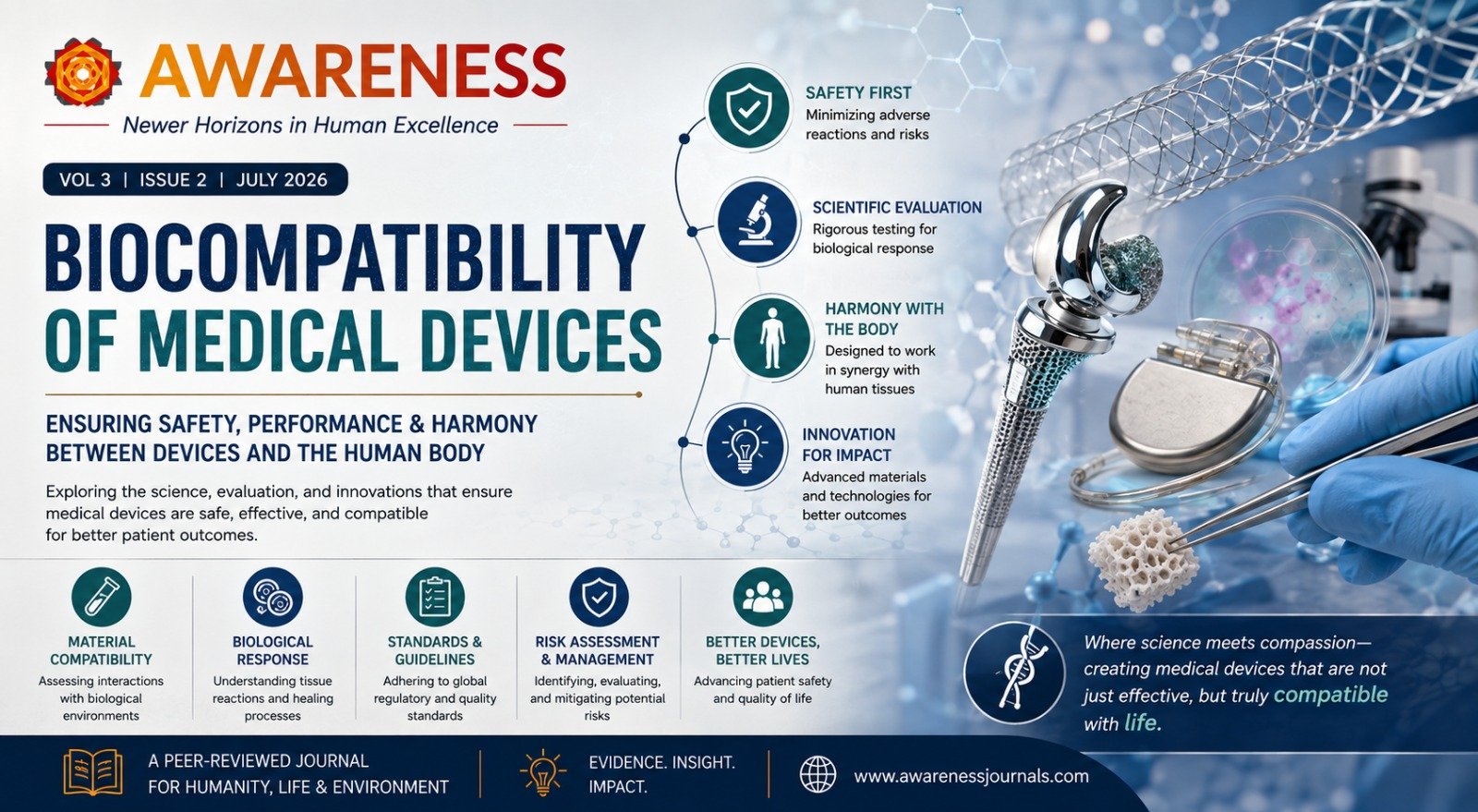
Biocompatibility of Medical Devices
- Aug 11, 2026
- 180 views
Abstract
All objects used in the diagnosis and treatment of disease must elicit an appropriate host response. This property, referred to as biocompatibility, is governed by requirements codified in international medical de-vice standards, which define rigorous evaluation methods to ensure that only devices showing superior bi-ocompatibility are placed into clinical use.
This article, the first in a series on the biocompatibility of medical devices, introduces the framework used to categorise devices according to the nature and duration of their contact with the patient, and outlines the corresponding risk-based testing strategies required to ensure that no unacceptable biological effects occur during clinical use.
Subsequent articles in the series will expand on these foundations by addressing chemical characterisation methodologies, tests for cytotoxicity, irritation and sensitisation, systemic toxicity, genotoxicity and carcinogenicity, implantation-related effects, and the application of the 3Rs principle in the context of animal welfare. Together, this series will provide a structured overview of contemporary biocompatibility evalua-tion and its role in ensuring medical device safety.
Full Text
Medical Devices
The statutory definition of a medical device in the United States, as laid down in the Food, Drug, and Cosmetic Act, is notably broad. It includes instruments, apparatuses, machines, implants, in vitro reagents, and other articles intended for use in the diagnosis, treatment, or prevention of disease, or to affect the structure or function of the body without relying on chemical action.1 Similar definitions, albeit with jurisdiction-specific differences, exist in other regulatory regimes worldwide. For example, in the European Union, the Medical Device Regulation (EU MDR) also defines medical devices in broad terms, covering a wide range of products, from simple tools like bandages and tongue depressors to complex technologies such as implanted pacemakers and software used for medical purposes.2 These broad statutory definitions bring a highly diverse range of products within the scope of medical device regulations and necessitate regulatory frameworks that are sufficiently flexible and adaptable to accommodate this diversity.
Importantly, not all medical devices are designed to come into physical contact with patients or users. Software that supports clinical decision-making or imaging algorithms used for diagnostics, for instance, operate entirely through electronic interfaces and do not directly interact with the body. In contrast, other medical devices, such as catheters, surgical implants, and diagnostic swabs, are specifically designed to make physical contact with the patient, sometimes penetrating tissue or remaining in situ for extended periods. The interaction of such devices with the human body introduces a distinct set of safety considerations, particularly regarding host responses to the presence and materials of the device.
Biocompatibility
The concept of biocompatibility emerged with the development of implantable medical devices and was initially understood to mean that an ideal implant would be compatible with the biological host and would not provoke adverse reactions. During the early development of implantable devices (1940s - 1980s), materials used in the construction of medical devices were chosen for their minimal chemical reactivity, emphasizing the principle of "biological inertness". During this period, material selection increasingly focused on minimizing undesirable biological responses. Early metallic implants, constructed from plain carbon and vanadium steels, were prone to corrosion and were progressively replaced by more chemically stable alternatives such as stainless steels, passivated cobalt-chromium alloys, titanium and its alloys, and the platinum-group metals. Similarly, polymeric materials such as nylon and polyester, initially valued for their availability and versatility, were supplanted by alternatives that offered greater chemical resistance and durability, including polytetrafluoroethylene (PTFE), polymethyl methacrylate (PMMA), polyethylene, and silicone elastomers. Implanted materials were chosen to minimize the risks associated with corrosion or degradation products, residual additives, or contaminants that could provoke local or systemic effects. Accordingly, biocompatibility criteria gradually came to be defined through a catalogue of "nons": suitable materials were expected to be non-toxic, non-immunogenic, non-thrombogenic, non-carcinogenic, non-irritant, and so on. This catalogue became, de facto, the defining feature of biocompatibility for early implantable medical devices.
Three factors eventually prompted a re-evaluation of this understanding of biocompatibility. First, it became clear that the biological response to a given material could vary depending on the site of implantation. Consequently, biocompatibility could not be determined solely by the intrinsic properties of a material but had to be considered in the context of its specific application. Second, an increasing number of medical applications required materials to actively interact with host tissues, rather than remain entirely inert. Third, certain applications necessitated that materials degrade over time within the body instead of remaining there indefinitely. Defining biocompatibility solely as the avoidance of harm was thus no longer appropriate. The current edition of ISO 10993-1 defines biocompatibility as the ability of a medical device or material to perform with an appropriate host response in a specific application.
This definition positions biocompatibility as a performance-based conceptual framework rather than an intrinsic property of the material used in the construction of the medical device. It is founded on three key principles: a material must actively perform rather than merely exist in the tissues; the host
response it elicits must be appropriate for the intended application; and the nature and suitability of this response may vary with context.
Although the conceptual definition of biocompatibility remains widely accepted, its practical interpretation continues to evolve. Contemporary biomaterials are increasingly designed not merely to avoid adverse reactions, but to actively modulate biological processes, such as tissue integration, immune signalling, angiogenesis, or controlled biodegradation. Consequently, modern biocompatibility assessments increasingly require consideration of dynamic host-material interactions rather than a simple absence of toxicity.
Key considerations for assessing biocompatibility
The biological response to a medical device is influenced by multiple factors, but the two most critical determinants are the invasiveness of contact between the device and the patient and the duration of that contact. These parameters form the foundation for categorizing medical devices for risk assessment and biocompatibility evaluation.
Invasiveness of contact refers to the extent to which a device penetrates or interacts with the body. The potential for adverse biological responses varies according to the tissue type involved, the device's intended function, and the local physiological environment. For example, devices that contact skin may primarily present risks of skin irritation or sensitization, whereas devices that contact circulating blood present additional risks, such as thrombosis or hemolysis. In the latest revision of the ISO 10993-1:2025 standard, several categories of contact have been defined to ensure selection of appropriate testing strategies. These categories include:
Non-contacting medical devices (for which no biocompatibility evaluation is required), Devices in contact with intact skin, Devices in contact with intact mucosal membranes, Devices in contact with either breached or compromised surfaces (skin or mucosal membranes) or internal tissues other than circulating blood, and Devices in contact with circulating blood.
The duration of contact is equally important, since the time a device interacts with the body significantly affects the host response. The ISO 10993-1:2025 classifies device contact as limited (≤ 24 hours), prolonged (>24 hours to 30 days), or long-term (>30 days). Devices intended for short-term use generally pose a lower risk of adverse biological effects, whereas devices intended for long-term use require a more comprehensive evaluation.
By integrating these two variables (invasiveness and duration of contact), medical device manufacturers can establish a risk-based biocompatibility testing programme. This systematic approach ensures that each device undergoes a level of biological evaluation commensurate with the potential severity of any adverse effects.
This framework is also reflected in US FDA guidance on the biological evaluation of medical devices. Table I presents a selected excerpt comparing the recommended biological effects for surface-contacting devices (intact skin, mucosal membranes, and breached or compromised surfaces) and implant devices (in contact with circulating blood). The information in Table I should not be interpreted as a checklist of tests to be performed for each device category. Rather, it provides a framework for consideration, and additional testing guided by scientific judgment should be undertaken where justified. Readers are referred to the full FDA guidance for further detail.
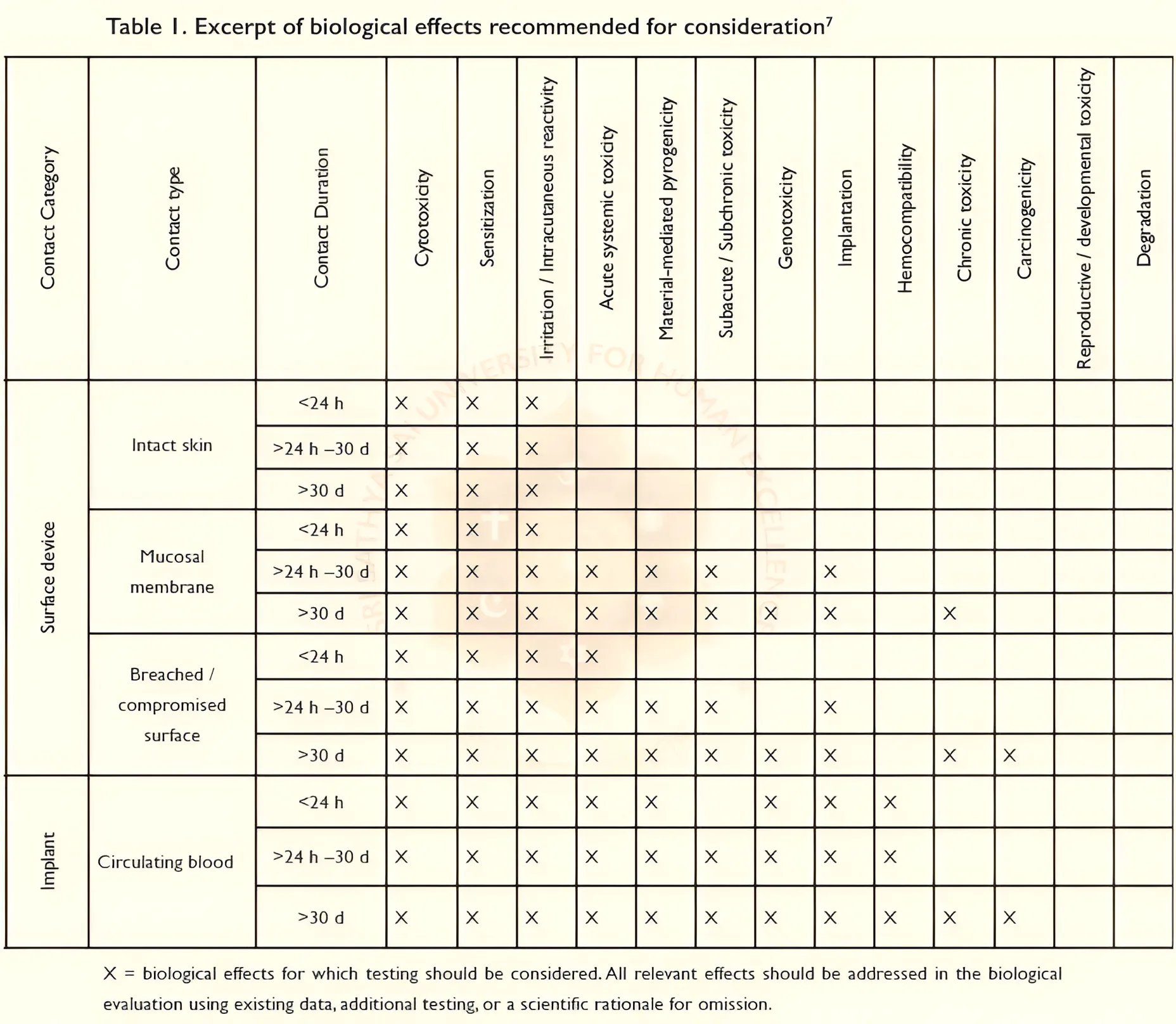
It is important to recognize that while this categorisation provides a practical framework for biological evaluation, it necessarily simplifies highly complex biological interactions. Devices with similar invasiveness or duration of contact may evoke substantially different biological responses depending on material chemistry, surface characteristics, degradation, mechanical stress, or patient-specific factors. Therefore, biological evaluation requires scientific judgment that goes beyond categorical classification.
Biocompatibility testing: chemical characterisation and biological endpoint tests
The evaluation of medical device biocompatibility begins with an understanding of its chemical composition. A chemical characterisation programme provides the foundation for identifying substances that may be released from the device during clinical use. This is supplemented by testing for specific biological effects, which assess the physiological or toxicological effects that could arise either from exposure to released substances or from the presence of the device itself. Taken together, these activities enable manufacturers to establish a comprehensive, risk-based biocompatibility evaluation.
Chemical characterisation aims to identify and quantify the extractable and leachable substances present in a medical device under conditions that simulate clinical exposure. These substances may originate from the raw materials of the device, manufacturing additives, processing aids, residues from sterilisation, or degradation products. Techniques such as gas chromatography-mass spectrometry (GC-MS), liquid chromatography-mass spectrometry (LC-MS), and inductively coupled plasma-mass spectrometry (ICP-MS) are commonly employed for the detection and quantification of organic and inorganic compounds. The chemical profile obtained from these experiments enables toxicologists to evaluate potential risks by comparing exposure estimates with known toxicological thresholds. If chemical data demonstrate that all extractables are below relevant toxicological thresholds, further evaluation is often limited to targeted biological testing. Conversely, where data gaps or substances of concern are identified, additional testing may be required to fully characterise the biological response. Consequently, a meaningful biological evaluation requires careful integration of analytical chemistry, exposure assessment, and toxicological risk assessment.
The emphasis on chemical characterisation reflects a broader regulatory transition towards toxicological risk assessment and reduction of unnecessary animal testing. Modern analytical techniques can detect extremely small quantities of chemical constituents, but the toxicological significance of many of these compounds cannot always be readily determined because interpretation is often complicated by unidentified compounds, complex mixtures, ultra-trace extractables, and degradation products formed during clinical use.
In the frameworks prescribed in ISO 10993-1:2025, biological evaluation requires consideration of various biological effects based on the invasiveness and duration of contact. Common tests for relevant biological effects include:
-
Cytotoxicity: Cytotoxicity is an initial in vitro screen for potential adverse biological effects associated with a medical device. This endpoint applies to devices with direct or indirect contact with the body, irrespective of contact duration, and is therefore broadly assessed across all device categories.
-
Sensitization and irritation: Devices that make contact with the body are evaluated for their potential to induce sensitization through exposure to allergenic constituents, as well as irritation arising from chemical or physical interactions such as surface contact or particulate release. This assessment generally applies to all devices regardless of contact duration.
-
Systemic toxicity: Devices capable of introducing constituents or particulates into the systemic circulation, lymphatic system, or cerebrospinal fluid may require evaluation for systemic toxicity, to assess potential effects on organs and tissues throughout the body. The depth of evaluation is linked to exposure duration, with more extensive testing typically required for prolonged or long-term contact (acute, sub-acute, sub-chronic, or chronic exposure scenarios).
-
Local effects after tissue contact: Devices that come into direct contact with specific tissues or organs are assessed for potential local tissue responses, including effects arising from particulate release. The extent of evaluation depends on contact duration, with more comprehensive assessment required for prolonged or long-term use. In general, such testing is not required for devices contacting only intact skin or those with limited-duration exposure, unless additional risk factors are present. Where appropriate, implantation studies may be used to characterise local tissue responses and support related assessments such as systemic toxicity or hemocompatibility.
-
Genotoxicity: Genotoxicity assessment is used to determine whether device constituents may induce genetic damage. The need for this test depends on both nature and duration of contact. In general, testing is not required for devices contacting only intact skin or for limited-duration exposure to tissues, with exceptions for implantable or extracorporeal blood-contacting devices. However, where materials of concern are present or other risk factors apply, additional assessment is warranted. Devices with prolonged or long-term tissue or blood contact typically require genotoxicity evaluation to ensure that exposure does not result in genetic damage or downstream adverse outcomes.
-
Carcinogenicity: Carcinogenicity assessment is considered where there is concern for either genotoxic mechanisms (e.g., DNA-reactive substances) or non-genotoxic pathways such as chronic inflammation or sustained proliferative responses. Routine carcinogenicity testing is generally not required for devices contacting only intact skin but may be indicated for long-term tissue or blood-contacting devices. Given the limited predictive value and resource intensity of traditional in vivo studies, evaluation is usually based on chemical characterisation and toxicological risk assessment. Identified carcinogens are addressed within the overall biological risk assessment regardless of contact type or duration.
-
Hemocompatibility: Devices in contact with circulating blood, whether directly or indirectly, require evaluation for hemocompatibility due to the potential for effects such as haemolysis or thrombosis. This assessment considers both chemical composition and surface properties that may influence blood-material interactions and flow behaviour. Integration of chemical and physical characteristics is therefore essential within the overall biological risk evaluation for blood-contacting devices.
Not all biological effects are relevant for every device. The selection of appropriate tests must be supported by a clear scientific rationale grounded in the intended use of the device, anatomical location, exposure duration, and chemical profile. For instance, a surface-contacting device making limited-duration contact with intact skin will only require evaluation of cytotoxicity, irritation, and sensitization, whereas a long-term intravascular implant would necessitate a comprehensive assessment of systemic toxicity, hemocompatibility, and implantation effects.
The integration of chemical characterisation and biological testing allows for a rational and risk-proportionate approach to biocompatibility evaluation. This ensures that testing is driven by scientific evidence and biological plausibility, rather than prescriptive or redundant requirements. Together, these steps form a bridge between material chemistry, biological safety, and clinical performance.
Risk-based biocompatibility assessment
Biocompatibility testing is undertaken to ensure that a device performs its intended function without causing unacceptable biological effects. Modern regulatory frameworks, particularly those defined by ISO 10993-1:2025 and the complementary guidance documents separately issued by other regulatory agencies, emphasize that the biocompatibility evaluation must be conducted using a risk-based approach rooted in scientific rationale and risk assessment principles.
A risk-based approach begins with the creation of a biological evaluation plan, which identifies the relevant biological risks associated with a device based on its invasiveness of contact and duration of exposure, as outlined above. The evaluation must consider the material composition of the device/packaging, its manufacturing processes, sterilization methods, and potential for chemical release or degradation under conditions of use. The chemical characterisation of the device provides the foundation for assessing toxicological risk. Only where the available data are insufficient to characterise the risk should additional in vivo testing be undertaken. In practice, this means that testing is not performed by default but rather justified based on evidence and scientific reasoning. For example, if extractables and leachables studies demonstrate that all potential chemical constituents of a device are below toxicologically relevant thresholds, additional long-term systemic toxicity tests may not be necessary. Conversely, if the chemical data reveal substances of concern or information gaps, further biological testing becomes warranted.
The risk-based framework integrates biocompatibility assessment within the broader context of risk management for medical devices. Biological evaluation is not a stand-alone exercise but part of an iterative process that identifies hazards, estimates and evaluates associated risks, and implements control measures throughout the lifecycle of the medical device. The outcome of this process is documented in a biological evaluation report, which provides the rationale for all testing decisions and conclusions on the overall biological safety of the device.
Ultimately, the risk-based paradigm promotes scientific efficiency and animal welfare, aligning with the 3R principles of replacement, reduction, and refinement in animal testing. By focusing on material characterisation and data integration, modern biocompatibility evaluations move away from a prescriptive testing paradigm and instead focus on a predictive assessment of biological safety.
Concluding remarks, challenges, and trends
Biocompatibility evaluation remains a central component of medical device safety assessment. Over the past several decades, the concept has evolved from a relatively simple focus on biological inertness toward a comprehensive, context-dependent evaluation of the interactions between medical devices and the host environment. It should not be understood as a fixed property of a material, but rather as the outcome of a dynamic interaction between the medical device and the biological system in which it is used.
In the assessment of biocompatibility, contemporary regulatory frameworks emphasize risk-based testing strategies that integrate chemical characterisation, toxicological evaluation, testing for biological effects, and scientific justification within an overall risk management process. As medical technologies continue to evolve, biological evaluation frameworks will likewise require continuous refinement to ensure that innovation proceeds alongside strong assurance of patient safety. Scientific judgment will always remain essential in this process, particularly since biological responses are influenced by complex interactions among material composition, device design, tissue environment, and the duration of exposure.
A cornerstone of biocompatibility assessment is chemical characterisation, alongside computational toxicology and integrated risk assessment strategies. However, the increasing complexity of innovative medical devices presents new challenges for a comprehensive evaluation. Emerging technologies such as bioresorbable materials, nanostructured surfaces, and patient-specific implants may exhibit biological behaviours that are not always fully captured by existing testing paradigms. In parallel, advances in mass spectrometry have significantly improved the sensitivity of analytical detection, enabling the identification of increasingly small quantities of extractable and leachable substances. However, this enhanced sensitivity is not always matched by toxicological interpretability. Chemical profiles frequently include unidentified compounds, mixtures of poorly characterised constituents, or substances for which toxicological data are limited, absent, or derived from non-comparable exposure contexts. As a result, the toxicological significance of such findings cannot always be reliably established, which may reduce the overall confidence in exposure-based risk assessments and, in some cases, limit the ability of the chemical characterisation programme to fully support biological safety evaluation.
Despite these challenges, the evolution of biocompatibility assessment reflects a clear transition toward more rational, predictive, and evidence-based evaluation strategies. The integration of chemical, biological, and computational approaches within a risk management framework has significantly improved the scientific robustness of medical device safety assessment. Continued methodological development, combined with informed scientific judgment, will remain essential to ensure that biocompatibility evaluation keeps pace with technological innovation while maintaining a high level of patient safety assurance.
Next in this series: chemical characterisation and toxicology
The biological response to a medical device is strongly influenced by its chemical composition. Chemical substances, including residual monomers, additives, processing aids used during manufacture, and degradation products, represent the primary contributors to adverse biological effects. Consequently, chemical characterisation of extractable and leachable substances forms a cornerstone of biocompatibility assessment, requiring potentially hazardous compounds to be identified, quantified, and evaluated prior to, or in parallel with, biological endpoint testing.
In the next article of this series, we will discuss methodologies used to characterise chemical substances that are extracted from, or leach from, medical devices. This will include solvent extraction, mass spectrometry techniques, and the subsequent toxicological evaluation used to contextualise these findings within a risk-based framework. Understanding the chemical composition of a device is essential for anticipating host responses, guiding in vitro and in vivo testing strategies, and ensuring that medical devices perform safely in their intended clinical applications.
Supplementary Materials: None.
Author Contributions: Sole author.
Funding: None.
Acknowledgments: None.
References
-
Food, Drug, and Cosmetic Act, 21 U.S.C. § 321(h)(1).
-
Regulation (EU) 2017/745 of the European Parliament and of the Council of 5 April 2017 on medical devices.
-
Williams, D. F. On the mechanisms of biocompatibility. Biomaterials 2008, 29, 2941-2953.
-
ISO 10993-1:2025 - Biological evaluation of medical devices Part 1: Requirements and general principles for the evaluation of biological safety within a risk management process.
-
Anderson, J. M., Rodriguez, A. & Chang, D. T. Foreign body reaction to biomaterials. Semin Immunol 2008, 20, 86-100.
-
Franz, S., Rammelt, S., Scharnweber, D. & Simon, J. C. Immune responses to implants - a review of the implications for the design of immunomodulatory biomaterials. Biomaterials 2011, 32, 6692-6709.
-
FDA. US FDA Guidance on Use of International Standard ISO 10993-1, "Biological evaluation of medical devices - Part 1: Evaluation and testing within a risk management process".
-
Sussman, E. M. et al. Chemical Characterization and Non-targeted Analysis of Medical Device Extracts: A Review of Current Approaches, Gaps, and Emerging Practices. ACS Biomater Sci Eng 2022, 8, 939-963.
-
Wang, H. et al. Chemical Characterization of Leachables in Catheter Device. ACS Omega 2022, 7, 48291-48300.