Designing a Circadian-Aligned Educational Timetable for Residential University Education:Integrating Modern Chronobiology and Ayurvedic Dinacharya
- Aug 12, 2026
- 201 views
Abstract
Educational timetables are usually organized according to academic and administrative requirements, with limited attention to students’ biological rhythms. However, chronobiology shows that health, performance, and wellbeing are closely influenced by the time of day. This paper presents the design of a circadian-aligned annual timetable at Sri Sathya Sai University for Human Excellence, India. The framework also draws upon the Ayurvedic principle of Dinacharya, or daily routine. A descriptive research design was adopted based on the educational practices followed at the institution. The university’s daily timetables and annual calendar were analyzed. These schedules had evolved through nearly three years of planning, implementation, review, and revision. Scientific literature and classical Ayurvedic texts were also examined to identify principles related to sleep, nutrition, physical activity, intellectual learning, experiential engagement, spiritual practice, and rest. The resulting framework includes coordinated timetables for working days, examinations, holidays, vacations, sports, internships, conferences, and other institutional activities. These schedules follow a consistent daily rhythm throughout the academic year. The framework is based on a residential educational model covering five interrelated domains: Spiritual, Intellectual, Personal, Experiential, and Regenerational development. Together, these domains support academic learning, physical health, practical skills, personal growth, spiritual awareness, nutrition, sleep, and recovery. Although the study does not quantitatively measure the effect of the timetable on students’ performance or well-being, it shows how chronobiology and Ayurvedic principles can be integrated into educational planning. The study offers a useful framework for residential institutions seeking to organize learning in harmony with biological rhythms and holistic development.
Full Text
1. Introduction
The organization of one's activities plays a vital role in a person's health, performance, and wellbeing. Though educational establishments care about the syllabus, teaching methods, and evaluation strategies, they rarely consider whether the time schedule fits human biology. The field of chronobiology has explored the relevance of the timing of our sleep, nutrition, sport, and hard work 3.4. Thus, the very organization of our time emerges as a significant concept.
Chronobiology focuses on the chronology of bodily functions 3. More specifically, the circadian (daily) rhythms of sleep- wake cycles, hormonal response, body temperature, alertness, and other vital signs, regulate physiological processes 4.6.
A circadian rhythm is a process that follows the daily cycle; thus, it depends on the time of the day 3.6. The pattern occurs due to the body's internal clock, which is programmed by external factors 7. For instance, light and exercise can affect the clock, thereby aligning a specific physiological process with certain hours 4.7.
Disruptions of the circadian rhythms cause health issues including learning and concentration problems, increased risks of metabolic syndrome, and psychological dysfunction 1.8.9. Therefore, chronological health has become a topic of interest among scientists, and the study has broad implications, including education.
The chronological organization of bodily processes was acknowledged in the ancient world. For example, the traditional system of medicine and science called Ayurveda recommends following the circadian rhythms to optimize health and wellbeing. The ancient wisdom has been systematized in the concept of Dinacharya, a guide for arranging sleep, nutrition, sport, work, relaxation, and other activities in accordance with the circadian rhythms 10.
Ayurveda and chronobiology are different systems, but they share broad similarities, regarding the basics of daily life 5.11. The similarities are crucial, as chronological health can become an integral part of education.
A residential educational organization represents an ideal model for incorporating chronological health into the daily life of students. Indeed, the students of residential universities do not have much freedom, as their daily activities are determined by the staff. Simultaneously, the university setting allows making global changes to the organization of students' activities.
This study is centered at Sri Sathya Sai University for Human Excellence, Karnataka, India. This university gives equal importance to Para Vidya and Apara Vidya. The entire years routine is based on this undertone.
The entire day is organized chronologically by the institution as though it were a single academic entity. To put it another way, the staff views daily practices that promote health as an essential component of education. As a result, the university has incorporated Ayurvedic Dinacharya's teachings on athletics, diet, health, and sleep into the everyday schedules of its students.
Despite the lack of research on the subject, chronological health can be a crucial component of schooling 1.12. Researchers have rarely systematized the chronobiology- based recommendations for educational institutions, despite the fact that chronological science has received a lot of attention 1.3.
The applicability of traditional Indian medicine in the setting of higher education has also received little attention from academics. Consequently, a chrono- review that investigates the use of chronological health in the residential university education paradigm can add significantly to the body of current knowledge. The results will, in fact, demonstrate the possible use of chronological health in education, which will improve both the quality of education and the wellbeing of students.
However, this study's scope is restricted to a particular educational organization's historical examination. Furthermore, the study did not assess students' wellbeing, despite showing the possible advantages of a daily plan that is organized chronologically.
Because of its possible ramifications, chronobiology is an emerging topic of study that has garnered significant attention. This research shows how students at residential institutions might incorporate the concepts of chronological health into their everyday routines. As a result, adhering to chronobiology's suggestions will help the kids in many ways.
However, the study just provides an overview of Sathya Sai University's chronologically organized curriculum. The results are intended to improve the general well- being of residential university students. However, the study's conclusions are restricted to outlining the advantages of chronological health. As a result, the study urges educational institutions to view the subject as an essential component of education.
2. Background and Literature Review
2.1 Circadian Rhythms and Human Performance
In order to enable the synchronization of physiological and behavioral processes, organisms experience biological rhythms, which are cyclical patterns lasting around twenty- four hours 3.7. The bulk of physiological processes, including hormone synthesis, metabolism, body temperature, immunological response, and sleep- wake cycles, are regulated by these rhythms, which start in the hypothalamic structure known as the suprachiasmatic nucleus. Physical activity, eating, and social interactions can temporally gate certain physiological processes, but the light- dark cycle is the most common way that these rhythms are entrained 4.7.
Deviations from natural cycles have an impact on human performance, learning, health, and emotion, according to chronobiology, the science of biological rhythms. Research over the past 20 years has shown that temporal structure can enhance both psychological stability and physiological well- being in sleep/wake, light exposure, eating routines, and physical exercise 12.13. Research has demonstrated that interventions that consider the human body's circadian structure can enhance mood, sleep, cognition, metabolism, and cardiovascular health 14.
It can be argued that, given the extensive scientific literature on the health benefits of temporal organization, the principles of biological timing should be used in clinical as well as educational settings in order to benefit human health.
2.2 Chronobiology in Education
Numerous educational research have demonstrated that how sleep, classes, meals, and physical exercise are arranged can all have an impact on learning 12.14. Lack of sleep has been demonstrated to impair motivation, focus, and memory consolidation in the classroom. Mood, alertness, and general performance have all been linked to the timing of sleep, wakefulness, classes, and meals. Regular meals and exercise have also been demonstrated to improve academic performance 15.
Furthermore, it has been suggested that the measurement of students' sleep cycles can be used to determine how university lessons should be structured. However, rather than examining the temporal organization of a full day, the majority of studies that have examined circadian preference in relation to learning have concentrated on specific elements of the daily schedule, such as the relationship between sleep and cognition 1.3.
The majority of students at residential universities are unable to choose where and when to sleep, eat, or exercise because classes, meals, and recreational spaces are overseen by the staff. This is significant when weighing organizational aspects of education against individual choice.
In order to provide students with the best possible living conditions in terms of education, nutrition, wellbeing, and spiritual enrichment, living in an educational institution allows for the investigation of a fully structured daily schedule where the staff designs the educational, feeding, and spiritual aspects of the student's life. The advantages of biological timing can be integrated into the creation of a completely planned daily routine in these kinds of establishments.
2.3 Ayurvedic View on Daily Living
It has been suggested that various levels of education have been organized using Ayurvedic principles. The ancient medical system hypothesized the presence of daily schedules that account for both individual and seasonal variation prior to the emergence of chronobiology as a distinct field.
According to the circadian fluctuations in physiology and mental activity, Ayurveda suggests scheduling cleanliness, meals, exercise, study, social interactions, meditation, and sleep. It may be inferred that the daily timetable follows the transitions between daylight and nighttime activities, despite minor variations between sources. When it comes to the best times to eat, sleep, meditate, exercise, and interact with others, Ayurvedic recommendations and chronobiology findings are quite consistent.
In terms of planning daily activities around the diurnal change of hormone concentrations, it can be argued that the ancient medical system adheres to the principles of contemporary endocrinology. However, Ayurveda proposes that daily activities should be planned around changes in Pitta, Kapha, and Vata dominance, whereas chronobiology links physiological fluctuation to the action of the endocrine system. One may claim that the principles of chronobiology and Ayurveda are similar, and that the variances between the two can be explained by the diverse chronological structures proposed by various sources.
2.4 Chronobiology and Educational Timetable Design
Although research has demonstrated that temporal organizing principles can improve performance and health, chronobiology has not yet been used to construct institutional schedules. It is crucial to remember that the majority of colleges create their schedules based on the infrastructure and teacher availability on campus. Because SSSUHE is residential, it is possible to experiment with an ideal schedule that would align students' daily activities with their circadian rhythms.
While academics have historically been the focal point of education, it is crucial to remember that holistic student development necessitates the inclusion of spiritual, physical, character- building, and experiential aspects of development in addition to physiological maintenance. To improve student wellness, Sri Sathya Sai University for Human Excellence has implemented holistic development principles at the individual level. It became feasible to coordinate the planning of food, entertainment, and education in line with the tenets of chronobiology and Ayurveda when the new educational system was created across departments.
Over the last three years, the management of SSSUHE has worked on the design of a student- friendly schedule which would synchronize multiple aspects of student life while following a consistent timeline without disrupting the academic syllabus.
2.5 Research Gap
Numerous studies have been conducted on the impact of circadian variation on health and education, as well as the applicability of Ayurvedic texts as temporal organizing guides, according to the literature examined for this work. It has been demonstrated that whereas the majority of chronobiology research concentrates on specific facets of physiology, Ayurvedic principles recommend the best times to complete everyday activities. There is little data on the effects of applying comparable organizational strategies at a communal level, despite a wealth of research demonstrating that strict adherence to a schedule of meals, recreation, education, and sleep can improve individual health 1.3.12.
The organizational features of student life at a residential institution are a research gap that this paper aims to fill. In order to arrange meals, entertainment, and education in line with the principles of biological and Ayurvedic temporal structure, SSSUHE management has proposed a fully- integrated educational timetable, which is the subject of this study. This research aims to review the literature on the principles of daily schedule organization and assess the viability of establishing a comparable system at SSSUHE, rather than evaluating the impact of such a timetable on student health.
3.Materials and Methods
3.1 Study Design
An institutional design- based descriptive study was conducted to explore the development of a chronological educational timetable at Sri Sathya Sai University for Human Excellence (SSSUHE), Karnataka, India. The emphasis was on designing the university timetable as opposed to examining physiological or educational outcomes. Hence, the study concentrated on the content of the timetable according to contemporary chronobiological and Ayurvedic literature 3.
3.2 Institutional Setting
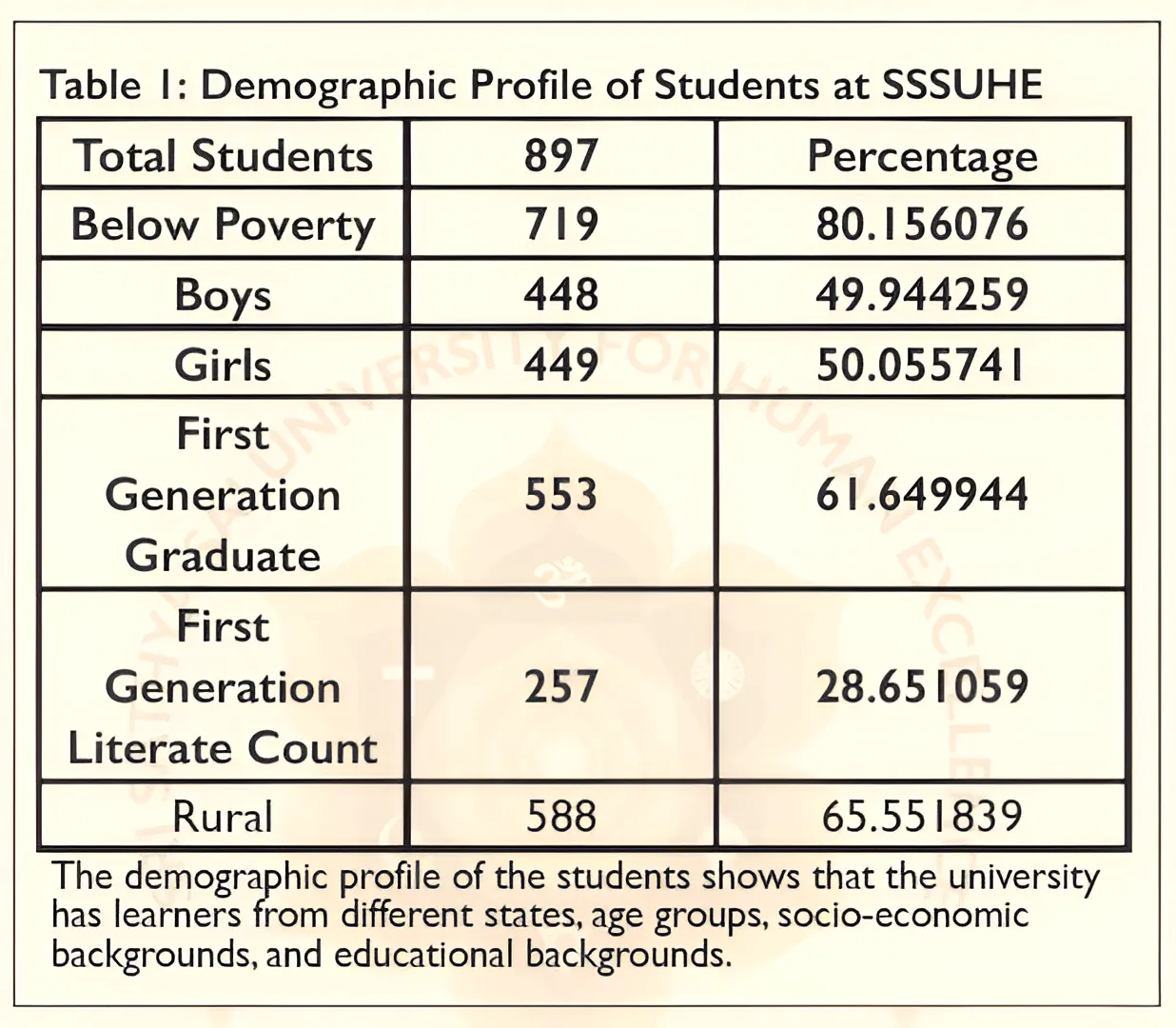
SSSUHE is a residential educational institution offering quality education and value- based lifestyle, hostel management, sports activities, and spiritual development. Given that the students live within the campus all year round, the University has the opportunity to manage not only their education but also their health and wellbeing. The academic year consists of distinct types of days, which include working days, exam days, vacation days, shibhira, dasara, sports days, and sundays, among others. Each type of days was given separate consideration
3.3 Development of the Timetable
The present timetable under study was developed over the course of three years through an iterative process. Thereafter, the timetables were discussed with the university administration and faculty to further hone the design. Particular consideration was devoted to temporal organization of the academic, spiritual, and physical development activities in order to achieve an appropriate balance between education, rest, and sport.
3.4 Data Sources
There were three categories of data sources used in this study. First, the actual timetable and the annual schedules for the SSSUHE, which had been designed by the University administration. The timetables specify the sequence of activities, which have to be undertaken on a given type of day. Second, a review of the literature on modern chronobiology with a specific focus on sleep physiology, chrono- nutrition, and educational health was undertaken. Ayurvedic texts and reviews on contemporary understandings of Dinacharya, Nidra, and Aahara were also consulted 3.4.14. Finally, the analysis of the timetable was performed.
3.5 Analytical Framework
The analytical framework consisted of four key aspects of the described timetable analysis. First, the chronological organization of the timetable was determined. Next, the activities were related to the principles of modern chronobiology. Third, a similar comparative analysis was made in the context of the Ayurvedic principles of Dinacharya 3.11. Finally, a conclusion regarding the concordance of the timetable with the underlying principles was drawn.
3.6 Limitations
Since the current study aimed at describing and analysing the features of the institutional timetable, as opposed to studying its physiological or educational outcomes, the focus of the current research was narrowed down to the design of the timetable. Physiological measurements were not taken, and the results should not be over- interpreted as proof of efficacy but rather understood as descriptions of concordance. Similarly, no psychological measures were undertaken.
3.7 Study Design
Since the study did not involve any human subjects or interventions, no approval from the ethics committee was needed.
4.Results
4.1 Development of the Institutional Timetable
The educational timetable that was eventually developed at Sri Sathya Sai University for Human Excellence was the result of an extended period of planning that lasted for approximately three years. It was not developed in a vacuum, but rather it was gradually adjusted to best suit the needs of the University, taking into account both institutional goals and the needs of the students in terms of physical, intellectual, emotional, and spiritual development.
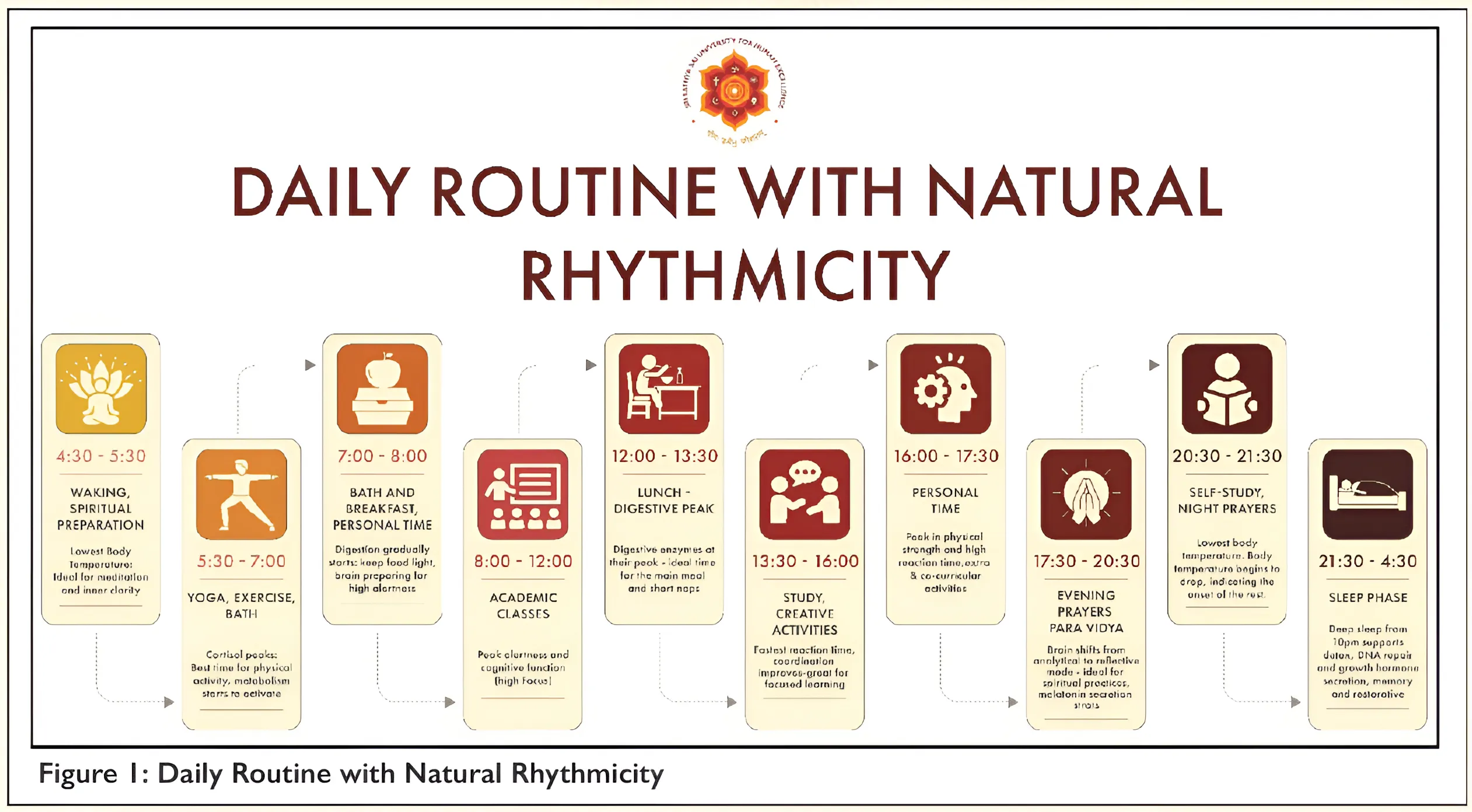
The primary emphasis was placed on establishing a consistent daily rhythm that would allow for both the needs of a residential university to be met, as well as the students’ well-being. Subsequent iterations of the project then focused on the allocation of time to specific activities, as well as the division of the day into segments that would allow for a balanced mix of sleep, meals, and other activities. The final product was a set of timetables that were developed in a coordinated manner that fit the goals of the University.
4.2 Structure of the Annual Timetable
In order to best fit the needs of the institution and its students, separate timetables were created for each category of days that fell within the annual academic calendar. They included days of work, examinations, vacations, Shibhira, Dasara, sports, Sundays, holidays, conferences, and internships.
Although the amount of time dedicated to specific activities varied from one timetable to the other, they were all coordinated in terms of the overall daily schedule. The primary physiological needs of the students, including the time dedicated to eating and sleeping, were consistent across all timetables, with variations in the amount of time dedicated to academic, experiential, and co- curricular activities depending on the purpose of the day 3.
4.3 Organization of Daily Activities
The working- day schedule was the primary reference point for all other timetables that were developed by the University. It can be seen that it follows a logical progression, starting with activities that would help students prepare themselves for the day ahead. Instructional time was then scheduled during daylight hours, with experiential, personal, and recreational activities being scheduled during the afternoon. Evening activities were then organized in a way that would allow for a smooth transition into the night 4.6. It should also be noted that the timetable was not focused on academic instruction exclusively, but rather it attempted to organize a full set of activities that would need to be completed throughout the day.
4.4 Distribution Across the Five Educational Domains
One of the most fascinating features of the working- day schedule is how the five major domains of human development - Spiritual, Intellectual, Personal, Experiential, and Regenerational - were incorporated into the schedule. This development is as follows:
As can be noticed, depending on the type of day, different domains were given preference in the number of hours allocated to them, in some cases, working days saw a strong emphasis on intellectual development, and hours for the remaining domains were allocated. In contrast, the days designated to devote time to the examination had a larger number of hours devoted to intellectual development.
Days that were devoted to internships had a strong emphasis on learning through experience, while the days assigned to sports had, as one might expect, a strong emphasis on physical development. Lastly, as it is clear from the spirit of the University, the spiritual development of the students was catered for in all the menus.
4.5 Alignment with Circadian Principles
The university timetables demonstrate the inclusion of various circadian principles as the schedules for the various types of days had a lot in common. Irrespective of the type of day, students' wake up and sleep times, as well as meal- times, were kept the same, helping to promote the consistency of their sleep cycles. The same can be said of times of the day for which the schedules incorporated the least physically strenuous, and relatively lighter, instructional activities, evening activities included for the students in preparation for sleep were also, less strenuous in nature.
It is clear from the employment of various circadian principles that significant thought has been applied to the institutional timetables from the perspective of the students' circadian activities rather than the inverse 16.
4.6 Key Observations
An analysis of the institutional timetables that were developed by Sri Sathya Sai University for Human Excellence allows for several key observations to be made. First of all, it can be noted that regardless of the category of day, the daily schedule remained largely consistent throughout the academic year.
Second, it can be seen that the focus of the timetables was not on academic instruction exclusively, as they also took into account the spiritual, physical, and experiential development of the students, as well as the need for rest and recovery. Third, it can be seen that the activities were organized in a logical progression throughout the day, with more intensive activities being scheduled during daylight hours and evening activities being focused on lighter activities. Fourth, it can be noted that the timetables allowed for a high degree of institutional flexibility while still following the general circadian principles.
Finally, the five- domain approach used by the University is a good example of how a single educational timetable can be used to balance the needs of multiple areas of development. All in all, it can be concluded that the institutional timetables developed by Sri Sathya Sai University for Human Excellence represent a truly integrated approach to education.
5. Discussion and Conclusion
By using chronobiology in the creation of institutional educational frameworks, the current study expands on earlier applications of chronobiology in personalized lifestyle solutions. Although earlier research has examined the effects of circadian rhythms on sleep, metabolism, and cognitive development as well as their relationship to health, there hasn't been as much published on how these discoveries relate to university scheduling 13,4. The SSSUHE Experience demonstrates how educational schedules can be created using the idea of biological time while taking into account all institutional and academic issues.
The uniformity of academic and institutional days across major categories is an illustration of the new schedule's flexibility.The arrangement of waking, eating, physical activity, and sleep is maintained to the greatest extent possible, even though workdays, tests, internships, athletic schedules, and vacations need significantly changing time divisions. This is consistent with modern theories of circadian control of behavior, which demonstrate how regular behavioral control maintains the body's biological clock 3,6.
Additionally, the study acknowledges the intriguing convergence between contemporary chronobiology and the Dinacharya Ayurvedic tradition 13. The two approaches agree on strict daily schedules, punctual completion of daily tasks, daylight physical exercise, and sufficient sleep, even though they concentrate on distinct fields of study and employ different ideas 5.
This study demonstrates the differences between these two fields of study and the combined models they provide, which can be very helpful in the construction of educational models, rather than arguing that they are the same. In the field of health, this design would be especially useful for integrating contemporary scientific ideas and evidence with conventional methods.
The SSSUHE framework's recognition that education is more than merely what takes place in the classroom is a key component. By incorporating the Spiritual, Intellectual, Personal, Experiential, and Regenerational domains into its schedule, the SSSUHE framework clearly sets itself apart from other schedules that prioritize academic instruction over personal growth, wellbeing, and recuperation. The domain- based framework provides educational planners with a strong tool to assess how well the institution's objectives are applied to the many areas of student life.
Additionally, the results go beyond residential universities.A number of the framework's fundamental concepts, such as the scheduling of learning interventions using biological time, the balance of learning interventions, and the integration of both recovery and movement, could be applied in schools, colleges, and professional education systems, even though it is unlikely that the entire framework could be directly relevant to other institutions 9,12. The design of timetables as part of the learning environment has to be a targeted topic as more and more higher education addresses the issues of student mental health, stress, and lifestyle- related diseases 9.
This study has certain limitations.The creation of a schedule was the main topic of discussion rather than how it actually affects pupils. Because of this, the results are highly consistent with some of the fundamental principles of chronobiology and Ayurveda; however, no connections to improvements in academic achievement, psychological well- being, or physical health were found. Another problem is that this framework was created for totally residential universities, which have a single educational philosophy.As a result, it will probably need to be adjusted to be applicable in various settings.
Future studies on the subject should concentrate on the educational and health results of students lives controlled by biologically optimized timetables rather than just analyzing the schedule.To offer strong evidence for the efficacy of this strategy, longitudinal studies evaluating the effectiveness of such educational settings with control groups of students attending residential and non- residential educational institutions are necessary 1.
This study emphasizes how chronobiology and the Ayurvedic idea of Dinacharya can be used to structure instructional procedures at residential universities. Over the course of three years, it was carried out using the iterative feedback loop method, which aided in optimizing the first iteration of the schedule.The study demonstrates how the residential education idea can incorporate biological rhythms into the planning of extracurricular, recreational, and instructional activities.
This study uses the example of SSUHE to show how the ideas of contemporary chronobiology and traditional Indian Ayurveda might be used in practice, but it makes no claims about providing a general solution for optimizing the time schedule of students at residential educational institutions. According to the study, students' health can be enhanced and the educational process can be optimized by scheduling their time according to their biological rhythms and Ayurvedic principles. Time management will be a crucial component of the entire experience as residential education continues to gain popularity among parents and students worldwide owing to its distinctive educational results.
Supplementary Materials: Not Applicable
Author Contributions: Conceptualization of the research work by Dr. Thothathri Venugopal. Analysis, flow of the paper and coordination with infographic design by Roopa C.
Both the authors have read and agreed to the published version of the manuscript. The tables were sent for reference of reviewers and need not be included for publication of the paper.
Funding: None
Institutional Review Board Statement: Not Applicable
Informed Consent Statement: Not Applicable
Data Availability Statement: Not Applicable
Acknowledgements: We thank Sri Sathya Sai Premamruta Prakashana for designing infographic pictures of distribution of Nutrients in the menu pattern of Sri Sathya Sai University for Human Excellence.
Conflict of interest declaration: We have no financial, personal, professional, or institutional conflicts of interest that could have influenced the conduct, findings, or interpretation of this research.
References
-
Abbott SM, Malkani RG, Zee PC. Circadian disruption and human health: A bidirectional relationship. Eur J of Neuroscience. 2020;51(1):567-583. doi:10.1111/ejn.14298
-
Ojha DrPP. CIRCADIAN RHYTHM VARIATIONS ACROSS PRAKRITI TYPES. IJMSCI. 2023;3(2):38-50. doi:10.56815/IJMSCI.V312.2023/38-50
-
Morin R, Forest G, Imbeault P. Circadian rhythms revealed: unraveling the genetic, physiological, and behavioral tapestry of the human biological clock and rhythms. Front Sleep. 2025;4:1544945. doi:10.3389/frsle.2025.1544945
-
Kim TW, Jeong JH, Hong SC. The Impact of Sleep and Circadian Disturbance on Hormones and Metabolism. International Journal of Endocrinology. 2015;2015:1-9. doi:10.1155/2015/591729
-
ML L, Chandran HC, Irshad H, C U, P Nair L. Ayurvedic perspective of Circadian Rhythm. 2021;6(2).
-
Zisapel N. New perspectives on the role of melatonin in human sleep, circadian rhythms and their regulation. British J Pharmacology. 2018;175(16):3190-3199. doi:10.1111/bph.14116
-
Golombek DA, Rosenstein RE. Physiology of Circadian Entrainment. Physiological Reviews. 2010;90(3):1063-1102. doi:10.1152/physrev.00009.2009
-
Erren TC, Morfeld P, GroB JV, Wild U, Lewis P. IARC 2019: "Night shift work" is probably carcinogenic: What about disturbed chronobiology in all walks of life? J Occup Med Toxicol. 2019;14(1):29. doi:10.1186/s12995-019-0249-6
-
Desai D, Momin A, Hirpara P, Jha H, Thaker R, Patel J. Exploring the Role of Circadian Rhythms in Sleep and Recovery: A Review Article. Cureus. Published online June 3, 2024. doi:10.7759/ cureus.61568
-
Yadav S. ASHTANGA VINYASA YOGA. https://books.google.co.in/books?id=JozbEQAQBAJ
-
Jhade SK, Verma P, Pathak PK, Kalidoss K, Tripathi MK, Shrivastava R. Ayurvedic Biology for Holistic Healing. In: Kumar A, Tripathi MK, Maheshwari NV, Kumar S, eds. Innovations in Ayurvedic Nutrition. Springer Nature Singapore; 2025:215-227. doi:10.1007/978-981-95-1213-3_11
-
Valdez P. Circadian Rhythms in Attention. Yale J Biol Med. 2019;92(1):81-92.
-
Haroon H, Pedada DR. Cultural and health perspectives of circadian rhythms and human sleep. Chronobiology International. Published online June 1, 2026:1-15. doi:10.1080/07420528.2026.2682 482
-
Oftedal S, Fenton S, Hansen V, et al. Changes in physical activity, diet, sleep, and mental well-being when starting university: A qualitative exploration of Australian student experiences. Journal of American College Health. 2024;72(9):3715-3724. doi:10.1080/07448481.2023.2194426
-
Biddle SJH, Asare M. Physical activity and mental health in children and adolescents: a review of reviews. Br J Sports Med. 2011;45(11):886-895. doi:10.1136/bjsports-2011-090185
-
Rizvi SI, Majumdar G. Circadian Clock and Aging. Springer Nature Singapore; 2024. doi:10.1007/978- 981-97-6695-6
Disclaimer/Publisher's Note: The statements, opinions and data contained in all publications are solely those of the individual author(s) and contributor(s) and not of SSUHE and/or the editor(s). SSUHE and/or the editor(s) disclaim responsibility for any injury to people or property resulting from any ideas, methods, instructions, or products referred to in the content.