The Concept and Model of the Humane Quotient
- Apr 10, 2026
- 384 views

Abstract
Various quotients have been proposed and explored in existing literature to measure different aspects of intelligence and emotions in humans. In this paper, a novel construct, the Humane Quotient (HuQ), along with a conceptual model is introduced, which would help to evaluate and understand the extent to which an individual is aligned with the universal concept of One World One Family (OWOF). This model is based on Eight Core Universal Humane Values: Selflessness, Empathy, Integrity, Acceptance, Responsibility, Equity, Diversity and Inclusivity (EDI), which are closely related to the eight identified main facets of the concept of OWOF. An outline of the methodology of evaluation, the assessment of HuQ, and eight related quotients are also discussed.
Full Text
Introduction
In today’s technologically advanced world, an individual’s character is still fundamentally rooted in their values. Humane values are essential for building a healthy and harmonious society. Sri Madhusudan Sai envisions a world where individuals are driven by the welfare of others. He refers to this vision as OWOF. We introduce a Humane Quotient Model that provides a way to assess how much an individual embodies this ideal, by evaluating the “Evolution of Care” within the person.
“Humaneness” in the context of “OWOF”
From the noun form of the adjective “Humane” comes the word “Humaneness,” which refers to the quality of compassion or consideration for others.1 The cultivation of Humane qualities is essential in modern times as they help an individual to evolve and find the true purpose of life, which is “Oneness with Everyone.” Quotients help to understand the degree of values in humans and cultural values in oneself.
Literature Review on Quotients in Practice
A Quotient is meant to quantify certain aspects or attributes of an individual. A quotient in mathematical terms means a result obtained by dividing one quantity by another. Similarly in the context of Humans, quotients such as Intelligence Quotient (IQ), Emotional Quotient (EQ), Social Quotient (SQ), and more are used to assess and understand specific attributes of personal and interpersonal functioning through certain calculations.2
There are many validated, partially validated, and non-validated quotients in practice. These include:
- Intelligence Quotient (IQ): IQ is a validated quotient, it measures cognitive abilities such as problem-solving, logical reasoning, and memory. Alfred Binet and Théodore Simon invented the Binet-Simon test, which was later revised and standardized by Lewis Terman.3,4
- Emotional Quotient (EQ): EQ is a partially validated quotient, it has the ability to understand and manage one’s own emotions while empathising with others. The term was coined in 1990 by Peter Salovey and John Mayer and later popularised by Daniel Goleman in his 1995 book Emotional Intelligence.5,6
- Cultural Quotient (CQ): CQ is a validated quotient, it represents one’s ability to relate and work effectively across cultures. It was developed by Soon Ang and Linn Van Dyne, editors of the Handbook of Cultural Intelligence: Theory, Measurement and Applications published in 2008.7
- Social Quotient (SQ): Although SQ is a partially validated model, it measures the ability to build and maintain relationships. Edward L. Thorndike laid the groundwork for the core concept of social intelligence in 1920.8 Social intelligence has received considerable attention with measurement and research summarized in 2019 by John F. Kihlstrom and Nancy Cantor in a chapter with the same title in The Cambridge Handbook of Intelligence.9
- Creativity Quotient (CQ): CQ is not a validated quotient, it is a metric designed to assess an individual’s capacity for creative thinking and innovative problem-solving.10 There was no single inventor of a standardised CQ. There is related work by J.P. Guilford (Structure of Intellect model)11 and E. Paul Torrance (Torrance Tests of Creative Thinking).12
- Spiritual Quotient (SQ): This is not a validated quotient, it is an emerging concept that measures an individual’s spiritual intelligence. Spiritual intelligence was popularised by Danah Zohar and Ian Marshall in an article published in 2000. They also published a book titled SQ: Connecting with Our Spiritual Intelligence.13
- Moral Quotient (MQ): This is not a validated quotient, it pertains to the ability to discern right from wrong and behave ethically. There is no single inventor on this quotient. The concept is more philosophical than scientific and is related to Lawrence Kohlberg’s stages of moral development14 and James Rest’s Defining Issues Test.15
- Wisdom Quotient (WQ): This is not a validated quotient. It reflects one’s unique ability to process information thoughtfully, weigh the consequences of their decisions, and choose the best course of action. Leading researchers are Paul Baltes who developed the Berlin Wisdom Paradigm16 other contributors are Robert Sternberg and Monika Ardelt.17,18
Validated Quotients refer to those backed by scientific research, psychological frameworks, or educational theories. Quotients or any psychological constructs are typically not validated at inception, but validated over time, through extensive research and testing on Reliability, Construct Validity, Criterion Validity and Peer-reviewed studies. In some cases, this process can take years or even decades.
Validation requirements of a quotient generally are 1) tests or measures used to derive it is reliable, valid, and standardised, and that the results are interpreted appropriately,19 2) formal studies through research and peer-reviewed literature20 and 3) widely accepted in education, psychology, leadership, or human resources domains.20 Partially validated quotients or non-validated quotients lack some or all these requirements.
Even though many quotients are not scientifically validated as standardised measures, they are still used because of their conceptual value, practical utility, contribution as emerging research, popularity, accessibility and filling gaps beyond the much-validated Intelligence Quotient.
The OWOF Concept
Sri Madhusudan Sai, who spearheads a unique global mission to teach the concept of oneness to humanity says, “When the concept of OWOF becomes a reality, there will be perfect peace in the world, because all the people and all the nations will be united in mutual trust, cooperation and coexistence.”21 He clearly says, “To the one who feels that everyone belongs to him, he considers the pain of others as his own, the joy of others as his own, the success of others as his own, and the failures of others as his own. He experiences the entire humanity as his own family.”22
In an age of war, nationalism, climate and value crises, this idea pushes back with a universal humanistic vision. Used in forums like the Group of 20 (G20) and United Nations (UN), especially by India, this OWOF concept sees Earth as part of one family protecting all life forms, not just human interests and it aligns with climate activism, indigenous perspectives, and ecological consciousness.
Aristotle once said, “Every art and every inquiry, and similarly every action and pursuit, is thought to aim at some good… this good has been declared to be happiness.” This paper aims to assess the humaneness in a person through evaluation of a novel Humane Quotient (HuQ) by considering the purpose of life: permanent and everlasting happiness. The cultivation of a broad-minded perspective enables us to achieve this happiness, devoid of any differences.
Literature
The concept of OWOF clearly indicates the interconnectedness between an individual and the world. Here’s how different traditions and thinkers have contributed to this idea in different ways.
The phrase OWOF implies the care should extend to all the beings in the world. Marcus Aurelius says “all men are kin.”23 Ubuntu (African Philosophy) says “I am because we are”.
Gandhi’s Sarvodaya is the core concept of Mahatma Gandhi’s philosophy, Sarvodaya means for the “Welfare of All.” This movement was a sincere and bold attempt to create the necessary atmosphere to bring together such individuals with an unwavering faith in the “Welfare of All”.24
In the book Where Do We Go From Here: Chaos or Community? (1967) Reverend Martin Luther King Jr. called for Global brotherhood against racism, poverty, and war.25 Immanuel Kant’s cosmopolitanism argued for a “universal community” where all humans deserve perpetual peace.26 The concept of “being in the world” by Martin Heidegger, suggested that our very essence is inseparable from the world we inhabit, highlighting the unity between a person and their surroundings.27
Concepts similar to OWOF across all religions and philosophies include the following:
- Hinduism – ‘Only a narrowminded person will think, “only these people belong to me, others are not mine!” But for a broadminded person, the whole world is his family.’28(p63) May everyone be happy; may everyone be healthy. May everyone see only auspicious scene everywhere; let no one experience any grief.28(p63)
- Buddhism - ‘Consider others as yourself’. Dhammapada 10.128(p57) ‘I have forgotten all differences between myself and others.’28(p58)
- Christianity - “Love your neighbour as yourself.” Mark 12:3129 Let us dream, then, as a single human family, as fellow travellers sharing the same flesh, as children of the same earth which is our common home. Fratelli Tutti, §8, Saint Francis of Assisi.30
- Confucianism – If a man has no humaneness what can his propriety be like? Being humaneness is good. If we select other goodness and this are far apart from humaneness, how can we be the wise?28(p62)
- Islam – “He is not a Muslim who eats his fill while his neighbour is hungry.”28(p70) “O mankind, We have created you from a male and a female and made you into nations and tribes so that you may know one another.”31
- Jainism – May the entire universe be blessed. May all being engage in each other’s wellbeing. May all weakness, sickness and faults diminish. May everyone everywhere be healthy, peaceful and happy in all respects. This is a common Jain prayer for universal well-being.32
- Judaism – I rejoiced with love for all people, as I could see Sophia in their hearts, guiding them. [The wisdom of Solomon, Chapter 7]28(p71) “Do not do to others what is hateful to you.” — Talmud, Shabbat 31a.33
- Jainism - “Parasparopagraho jivanam.” — Tattvartha Sutra “All life is bound together by mutual support and interdependence.”34
- Bahá’í Faith - “The earth is but one country, and mankind its citizens.”35
- Sikhism – “Recognize the whole human race as one.” Guru Gobind Singh Ji36
Other Perspectives on the concept of “OWOF”
- “In our obscurity, in all this vastness, there is no hint that help will come from elsewhere to save us from ourselves. It is up to us.” Carl Sagan.37
- “There are no nations, there are no religions, only one species—Homo sapiens.” Yuval Noah Harari.38
- “The good life is one inspired by love and guided by knowledge.” Bertrand Russell.39
- “We are all connected by the internet and modern transportation. We should work together to make a better world.” Stephen Hawking.40
Classification of Values
Values
Values are abstract concepts that have been studied since ancient times.41 Values play an important role in the holistic personality of students, teacher, administrators alike. These principles help oneself to decide what is right and wrong, and how to act in various situations.42 Values reside within each individual and the same is reflected by the individual’s character.
Humane Values
In dictionary terms, being “Human” describes the characteristics of a person, whereas being “Humane” describes the quality of having or showing compassion or care.43 Thus, we can conclude that “Human values” are the fundamental values that govern one’s behaviour and conduct. According to Gokak Committee, universal Human Values are identified as Truth, Righteous Conduct, Peace, Love, and Non-violence,44 which are essential for every individual to live with respect and harmony in the society.
We can also derive that “Humane Values” are built upon human values that govern one’s actions with more of care, empathy and compassion, which are essential in these modern times. These acts of compassion by an individual impacts the society at large which brings harmony in the society. In Sri Madhusudan Sai’s words, “Embrace the feeling that the entire world is your family, not just your immediate relatives. When we work together for the welfare of all, the world can live in harmony as one united family.”22
Literature Review on Usage of the Word ‘Human / Humane Value’
The phrases “Human / Humane Value” has been used by certain authors in different contexts. Here are the references that use the phrase “Human / Humane Value” and related phrases:
The phrases ‘the humane values of socialism’; ‘humane social thrust’; ‘a humane way of life’; ‘humane spirit individual cases’; ‘inherently humane European culture’; ‘To make international relations more humane is the only way out’; ‘solution in a humane and positive spirit.’45
Also, the phrases, ‘Some behaviour choices seem to be in self-interest but violate humane values.’ ‘Some behaviour choices honour humane values but harm self-interest.’ ‘Optimal behaviour choices align self-interest with humane values’ ‘Humane behaviour choices are motivated by appreciation, compassion, kindness, or love.’ ‘Humane values of appreciation, compassion, and kindness’ ‘Violating humane values creates an air of inauthenticity, while stimulating guilt, shame, and anxiety.’46
‘The ‘humane education’ movement is seen worldwide.’ ‘The focus of humane education is on values such as kindness, respect, and non-violence.’ It promotes empathy and compassion and helps individuals understand the perspectives of others and treat all beings with kindness and respect.’47
Classification of Values based on “Evolution of Care”
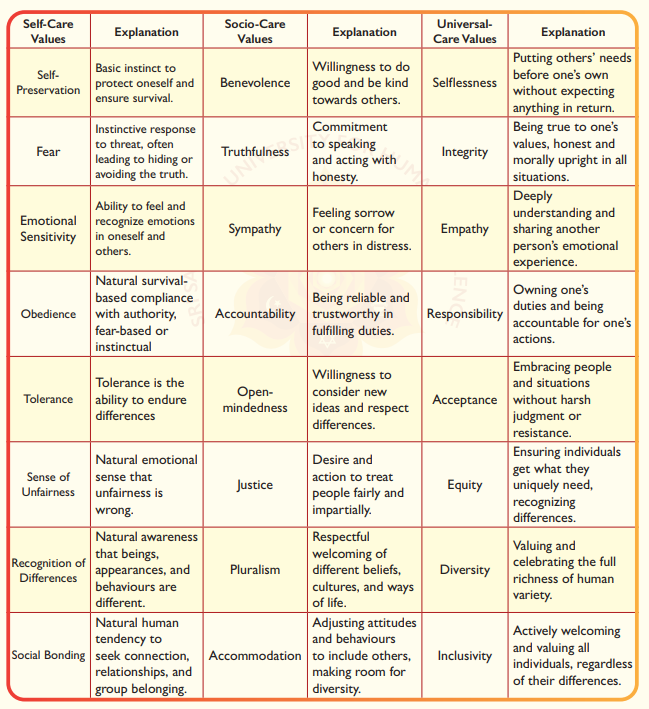
In this paper, we propose a new classification of values into three categories: Self-Care Values, Socio-Care Values, and Universal-Care Values. At the heart of this classification is the idea of an “Evolution of Care,” which is the evolution from self-care to universal-care. Our definitions are as follows:
a) Self-Care: Care solely on the individual with less/no regard for others.
b) Social-Care: Care for one’s family, friends, and community with kindness and loyalty.
c) Universal-Care: Care for all the people with compassion, kindness, and empathy.
In the analogy of “Stream, River and Ocean”, the water drop remains the same, but its form evolves. Just as the way water drop begins from the small stream, flows into the river and finally merges into the ocean. The evolution of care indicates how people grow from thinking about oneself to thinking about others to thinking about everyone in society. In other words, in the journey of life from ‘I’ to ‘We’ to ‘He.’48 Sri Madhusudan Sai says, “From the confines of an individual existence to embracing a multitude of strangers and finally experiencing the oneness of everyone and everything.”49 The transformation from Vanar (Animal nature) to Nar (Human nature) and finally to Narayan (Divine nature) is a symbolic journey often interpreted from the teachings of the Bhagavad Gita.50
Literature Review on Classifications of Values
- August Corrons Giménez and Lluís Garay Tamajón build upon Shalom Schwartz’s Theory of Basic Human Values. In their 2019 study, they propose a hierarchical model that organises values into three levels: First-Order Values (10 Values), Second-Order Dimensions (4 Dimensions), Third-order Clusters.41
- Abraham Maslow’s hierarchy of needs is a motivational theory that outlines five levels of human needs, from basic to Psychological to self-fulfilment.51
- William Glasser’s Choice Theory is a psychological framework that emphasises personal responsibility and the power of individual choice.52
- Lawrence Kohlberg’s Theory of Moral Development explores on moral development and social evolution have progressed together. Development proceeds through Pre-conventional, Conventional, and Post-conventional levels of reasoning.53
- Ken Wilber presents a comprehensive framework for understanding human development. Quadrants and Levels approach values through lines of development (e.g., cognitive, emotional, spiritual).54
- George Vaillant tracks value-related emotional development from primitive (e.g., denial, projection) to mature (e.g., altruism, humour, sublimation).55
- C.G. Jung in his works on Psychological Types and Individuation says values arise through the process of individuation, integrating shadow, persona, and true self.56,57
- Social psychologist Milton Rokeach, in his well-known instrument for measuring human values, designed a rank-order scaling of 36 values, including 18 terminal and 18 instrumental values.58
- Gokak Committee in 1981 identified universal human values – Truth, Righteous Conduct, Peace, Love, Non-violence and classified them into sub-values.44
Eight Core Universal Humane Values
Eight “Core Universal Humane Values”, which are identified by the authors as essential to lead to OWOF, in this model are: Selflessness, Empathy, Integrity, Acceptance, Responsibility, Equity, Diversity, and Inclusivity. The first five “Humane Values” are termed as “Humane Essence”, which refers to the context of an Individual. And the remaining three Humane values are in Global context. While the first five Humane Values (Selflessness, Empathy, Integrity, Acceptance, Responsibility) create the ethical and emotional foundation, the next three “Humane Values” (Equity, Diversity and Inclusivity) gives us the practical lens through which we apply those values in real world human interactions, addressing how we respect each other’s identities within a shared human community. A graphic representation of the HuQ model is given in Figure 1.
Five Core Universal Humane Values in Individual Context
- Selflessness: Selflessness is most plausibly thought of as putting others ahead of oneself.59 This helps oneself to shift his focus from self-interest to the well-being of others, which is central to humaneness.
- Empathy: Empathy is the ability to express concern.60 This feeling for others helps an individual to respond with genuine concern for others, this is an essential trait for the person with humane qualities.
- Integrity: Integrity is the state of being whole and faithful to one’s moral principles.61 When an individual acts according to one’s principles even when no one is watching, which is the core aspect of Universal Humane Value.
- Acceptance: Embracing thoughts, emotions, and other internal experiences without judgment and without trying to change them.62 It enables oneself to embrace everyone regardless of their backgrounds and faiths.
- Responsibility: Responsibility is an awareness of the obligation to contribute positively to society.63 This awareness is the hallmark for humaneness.
Our selection of the first five Humane Values (Human Essence) Selflessness, Empathy, Integrity, Acceptance, Responsibility can be mapped to the five universal values of Love, Truth, Non-Violence, Righteous Conduct and Peace, respectively.
Three Core Universal Humane Values in Global Context
- Equity: Creating an environment where all those with diverse identities are welcomed and valued.64
- Diversity: Diversity is recognising, respecting and celebrating each other’s differences.65
- Inclusivity: Inclusion means creating an environment where everyone feels welcome and valued.65
Figure 1. Graphic Representation of the HuQ Model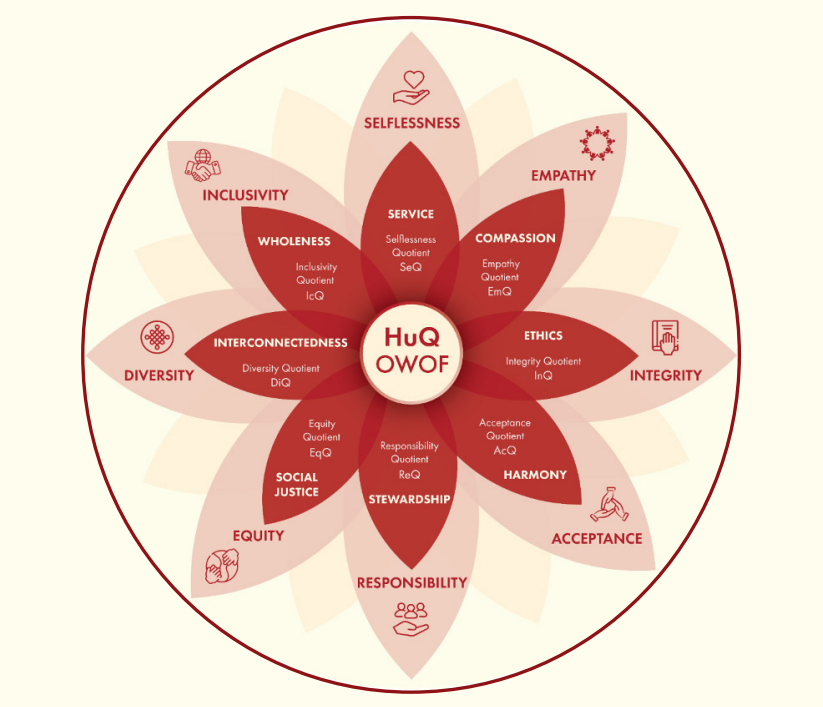
Human Essence and EDI for Humanness
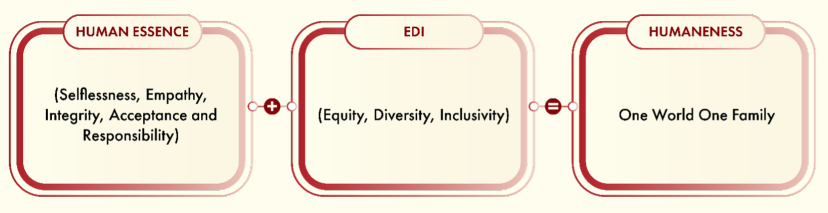
“Human Essence” represents the attribute or set of attributes that make human beings what they fundamentally are, which they have by necessity, and without which they would lose their identity as human beings.66 Equity, diversity, and inclusion (EDI) is a conceptual framework that promotes the fair treatment and full participation of all people, especially populations that have historically been underrepresented or subject to discrimination because of their background, identity, disability, etc.67
A graphic representation of Human Essence and EDI for Humanness is given in Figure 2. It can be noted that Selflessness, Empathy, Integrity, Acceptance, and Responsibility are set in the individual context, while Equity, Diversity, and Inclusivity are set in the universal context; all eight values should be developed simultaneously.
Figure 2. Graphic Representation of Human Essence and EDI for Humanness
Aspects of OWOF related to Eight Core Universal Humane Values
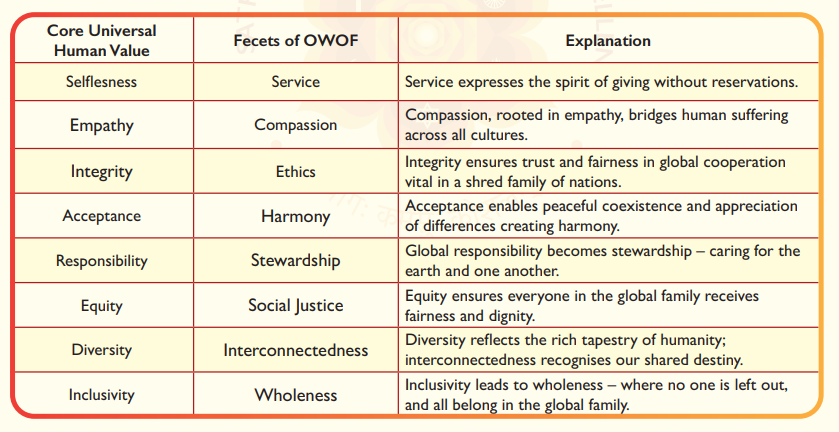
The idea of OWOF is that we embrace all with the feeling of oneness. Each of these aspects reflects the “Humane Values” in action. For example, Service is the driving force behind selflessness. Here are eight main aspects of OWOF which are related to the corresponding eight core universal “Humane Values.” The explanation is also given for better understanding.
Table 1. Core Universal Humane Values and Facets of OWOF
Methodology to Evaluate the HuQ
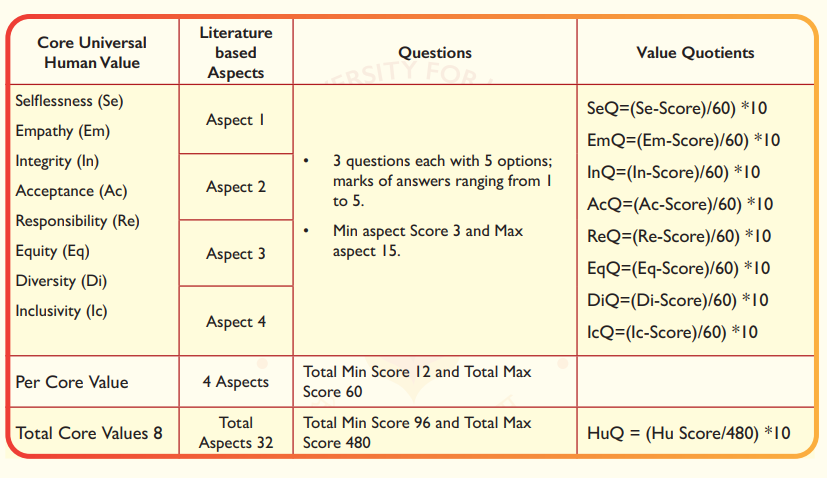
To facilitate the understanding the methodology to evaluate the Humane Quotient (HuQ), we have created a sample of questions based (as mentioned below) on selected literature, generally covering four aspects for each of the eight core universal “Humane Values.” These questions help us to understand the level of care in an individual. Each question includes five response options mapped to “Evolution of Care”: Self-Care values to Socio-Care values to Universal-Care values. A five-point Likert scale is used to assess the evolution of care. The 5-point Likert scale uses five answer options, including for midway options accommodating the evolving nature of care, to assess a respondent’s opinions.68
The HuQ Quotient has 96 questions in total. These questions help to assess an individual’s alignment with the eight-core universal Humane values. In this first phase of research, four keywords are selected by the authors for each core universal Humane value. Based on these keywords and the literature, four corresponding aspects are identified for each value. As the research progresses, additional keywords may emerge to further describe these core universal humane values. Each aspect is assessed using three different questions with responses recorded on a 5-point Likert scale. The proposed methodology of evaluation of HuQ is in Table 2.
Table 2. Evaluation of the Eight Quotients and Humane Quotient: the proposed approach to measuring the Humane Quotient (HuQ)
Each Quotient/Score can be divided into three phases of evolution of the related core value:
- Score 12 to 28 / Quotient 0.2 to 4.6 indicates the first level of attainment of the related core value.
- Score 29 to 44 / Quotient 4.7 to 7.3 indicates the second level of attainment of the related core value.
- Score 45 to 60 / Quotient 7.4 to 10 indicates the third level of attainment of the related core value.
Each HuQ score can be divided into three phases of “Evolution of Care”:
- 96 to 223 marks out of 480 (0.2≤HuQ≤4.6) reflects the individual is prioritising Self-Care
- 224 to 351 marks out of 480 (4.7≤HuQ≤7.3) reflects the individual is prioritising Socio-Care
- 351 to 480 marks out of 480 (7.4≤HuQ≤10) reflects the individual is prioritising Universal-Care.
Explanation for three ranges of the Quotient with respect to “Evolution of Care”
Table 3 explains the score ranges corresponding to the three evolutionary phases of the core universal Humane Value Care: Self-Care, Social-Care, and Universal-Care. It outlines each HuQ score range and provides a brief explanation for each phase.
Table 3. Table of Explanation of “Evolution of Care”
Value, Aspect, Questionnaire and their relation
Four aspects of each of the core universal Humane values are chosen based on the similar idea presented in its definition. The example of Selflessness is given here.
Core Universal Humane Value – Selflessness
Definition: Selflessness is most plausibly thought of as putting others ahead of oneself.59
Aspect 1: Selflessness represents divine, unconditional, volitional, and self-sacrificing love.69
Aspect 2: It is characterized by low levels of self-centeredness and a low degree of importance given to the self.70
Aspect 3: To a focus on meeting others’ needs above one’s own; showing concern for other people’s welfare and acting to help them.71
Aspect 4: It is based on a weak distinction between self and others, and between self and the environment as a whole, which takes the form of a sense of connectedness.70
Discussion on relation definition and 4 aspects
In this section we discuss on how these four aspects can be developed for each core universal humane value. The concept of Selflessness is putting others ahead of oneself, this value encompasses behaviour, intention and attitude of the person. The four aspects of selflessness have been framed based on the four keywords that characterise selflessness as described below. The key words are given below:
Aspect 1 Key words: Self-sacrificing love
Aspect 2 Key words: Low levels of self-centeredness
Aspect 3 Key words: Helping others
Aspect 4 Key words: Sense of Connectedness
Sample Questions Measuring the Four Aspects of Selflessness
Selflessness Aspect 1 has three questions.
Question 1. How regularly do you look for ways to support others?
Question 2. How often do you offer help to others without expecting anything in return?
Question 3. How often do you show respect and kindness to people from all walks of life?
Selflessness Aspect 2 has three questions.
Question 1. How often do you act with concern for others?
Question 2. How often do you extend help to someone, even if it takes your time?
Question 3. How often do you forgive someone even if they hurt you?
Selflessness Aspect 3 has three questions.
Question 1. How often do you think about others before thinking about your own comfort?
Question 2. How often do you contribute to the well-being of everyone?
Question 3. How often do you remain kind and helpful when someone is rude to you?
Selflessness Aspect 4 has three questions.
Question 1. How often do you treat strangers with the same care and concern as you do with friends or family?
Question 2. How often do you speak or act with kindness and care toward people regardless of their background, status, or opinions?
Question 3. How often do you feel happy when others are happy?
The above questions are one example of how to measure the “Selflessness” aspect of the Humane Quotient, the concept of measuring an individual’s humane qualities. Similar response scales could be used to measure the other seven core universal humane values.
Conclusion
The Humane Quotient (HuQ) represents a transformative model for assessing how “Humane” an individual is. By integrating “Human Essence” and EDI, the HuQ model offers a comprehensive and integrated approach to evaluate the care aspect of an individual. Through its practical approach, the HuQ helps us to realise individual potential and contribute meaningfully with the feeling of oneness.
Future research could further develop the questions for each aspect of the eight core values. A pilot survey with a random representative sample of respondents could be run to identify the best performing wording. Analysis of the pilot survey data would enable us to observe whether the proposed question wording best measures the different aspects of each aspect of the HuQ.
Author Contributions: Dr Thothathri Venugopal is responsible for the conceptualization of the model. Sai Krishna Rachiraju is responsible for the preparation of various aspects, including survey questions, infographic coordination, and structuring and flow of the paper.
Funding: None
Institutional Review Board Statement: Not applicable.
Informed Consent Statement: Not applicable.
Data Availability Statement: Not applicable.
Data Sharing: Not applicable.
Acknowledgments
We want to express our gratitude to Sri B N Narasimha Murthy, Former Chancellor, Sri Sathya Sai University for Human Excellence and Chief Mentor of Sri Sathya Sai Loka Seva Gurukulam Group of Institutions for his valuable insights on the paper. We extend our sincere thank Sri Sathyanarayana M. S., Trustee Prashanthi Balamandira Trust and Sri Venkateswarlu Vanka, Para Vidya Margadarshaka, for their significant contribution in shaping the value aspects of the model. We also extend our sincere thanks to Sri Sathya Sai Premamrutha Prakashana for designing the infographics that visually represent the model. We thank the editor/reviewer of Awareness Journals for their valuable inputs.
References
- Humaneness - Definition, Meaning & Synonyms. Vocabulary.com. Accessed May 3, 2025. https://www.vocabulary.com/dictionary/humaneness
- Sternberg RJ. Handbook of Intelligence. Cambridge University Press; 2000.
- Terman LM, Lyman G, Ordahl G, Ordahl L, Galbreath N, Talbert W. The Stanford revision of the Binet-Simon scale and some results from its application to 1000 non-selected children. J Educ Psychol. 1915;6(9):551-562. doi:10.1037/h0075455
- How Alfred Binet Helped Develop Modern Intelligence Tests. Verywell Mind. Accessed June 30, 2025. https://www.verywellmind.com/alfred-binet-biography-2795503
- Emotional Intelligence - Peter Salovey, John D. Mayer, 1990. Accessed June 30, 2025. https://journals.sagepub.com/doi/abs/10.2190/DUGG-P24E-52WK-6CDG
- Goleman D. Emotional Intelligence: Why It Can Matter More than IQ. Bantam; 2005.
- Handbook of Cultural Intelligence: Theory, Measurement, and Applications - Soon Ang, Linn Van Dyne - Google Books. Accessed June 30, 2025.
- Thorndike EL. Intelligence and its uses. Harpers Mag. 1920;140:227-235.
- Kihlstrom JF, Cantor N. Social intelligence. Handb Intell. 2000;2:359-379.
- Snyder A, Mitchell J, Bossomaier T, and Pallier G. The creativity quotient: An objective scoring of ideational fluency. Creat Res J. 2004;16(4):415-419. doi:10.1080/10400410409534552
- Guilford JP. The structure of intellect. Psychol Bull. 1956;53(4):267.
- Torrance EP. Torrance tests of creative thinking. Educ Psychol Meas. Published online 1966.
- Zohar D. Spiritual Intelligence: The Ultimate Intelligence. Bloomsbury Publishing; 2012.
- Kohlberg L. Stages of moral development as a basis for moral education. In: Beck CM, Crittenden BS, Sullivan E, eds. Moral Education. University of Toronto Press; 1971:23-92.
- Rest J, Thoma SJ, Narvaez D, Bebeau MJ. Alchemy and beyond: Indexing the Defining Issues Test. J Educ Psychol. 1997;89(3):498-507. doi:10.1037/0022-0663.89.3.498
- Banicki K. The Berlin Wisdom Paradigm: A Conceptual Analysis of a Psychological Approach to Wisdom. Hist Philos Psychol. 2009;11(2):25-35.
- Sternberg RJ. A balance theory of wisdom. In: The Essential Sternberg: Essays on Intelligence, Psychology, and Education. Springer Publishing Company; 2009:353-375.
- Ardelt M. Wisdom as expert knowledge system: A critical review of a contemporary operationalization of an ancient concept. Hum Dev. 2004;47(5):257-285.
- Foxman B. Molecular Tools and Infectious Disease Epidemiology. Academic Press; 2010.
- Reviewers | What is peer review? | Elsevier. www.elsevier.com. Accessed May 3, 2025. https://www.elsevier.com/reviewer/what-is-peer-review
- Multi-Faith Conference || Live from Argentina || 04 April 2023 - YouTube. Accessed May 3, 2025. https://www.youtube.com/watch?v=iruIY2aLHYc
- Eternal Thoughts. Sri Sathya Sai Premamrutha Prakashana. Accessed May 11, 2025. https://www.saiprakashana.org/eternal-thoughts/
- Marcus Aurelius Antoninus, Meditations, VIII:59. Smithsonian American Art Museum. Accessed May 7, 2025.
- Gandhi MK. Sarvodaya (The Welfare Of All). Navajivan Publishing House Ahamadabad. Accessed May 15, 2025.
- King Jr ML. Where Do We Go from Here: Chaos or Community? Vol 2. Beacon Press; 2010.
- Kautzer C. Kant, Perpetual Peace, and the Colonial Origins of Modern Subjectivity. Published online 2013.
- Guignon C. Martin Heidegger: Being and Time. In: Shand J, ed. Central Works of Philosophy, Volume 4. McGill-Queen’s University Press; 2006:92-110.
- Sanatana Dharma. Goodreads. Accessed June 30, 2025. https://www.goodreads.com/book/show/63139051-sanatana-dharma
- Hadsell H. Love Your Neighbour as Yourself. Ecum Rev. 2020;72(5):809-819. doi:10.1111/erev.12575
- Fratelli tutti (3 October 2020) | Francis. Accessed May 10, 2025. https://www.vatican.va/content/francesco/en/encyclicals/documents/papa-francesco_20201003_enciclica-fratelli-tutti.html
- Surah Al-Hujurat - 1-18 - Quran.com. Accessed May 3, 2025. https://quran.com/49
- Welcome to website of jainscience-rissios.org. Accessed May 10, 2025. https://www.rissios.org/j_universal.htm
- Family Discussion Guide: Esther Didn’t Dream of Being Queen. Accessed May 10, 2025. https://pjlibrary.org/beyond-books/pjblog/february-2025/family-discussion-guide-esther-didnt-dream-of-be
- Ravikanth G. Indian Philosophy and Environmental Ethics. GNOSI Interdiscip J Hum Theory Prax. 2021;4(1):47-63.
- Quotations | One Human Family | What Bahá’ís Believe. Accessed May 3, 2025. https://www.bahai.org/beliefs/essential-relationships/one-human-family/quotations
- Alam MJ. Understanding Humanism: The Sikh Perspective. Arts Fac J 8. 2018;9:12-13.
- A quote from Pale Blue Dot. Accessed May 3, 2025. https://www.goodreads.com/quotes/371944
- Harari YN. Sapiens: A Brief History of Humankind. NY: Harper Collins. Accessed May 10, 2025.
- A quote from What I Believe. Accessed May 3, 2025. https://www.goodreads.com/quotes/9858353
- Carl Sagan Quotes. BrainyQuote. Accessed May 3, 2025. https://www.brainyquote.com/quotes/carl_sagan_841914
- Giménez AC, Tamajón LG. Analysis of the third-order structuring of Shalom Schwartz’s theory of basic human values. Heliyon. 2019;5(6). doi:10.1016/j.heliyon.2019.e01797
- VALUES | English meaning - Cambridge Dictionary. Accessed May 3, 2025. https://dictionary.cambridge.org/dictionary/english/values
- “Human” or “Humane”? Accessed May 3, 2025. https://www.grammar-monster.com/easily_confused/humane_human.htm
- Aggarwal JC. Education for Values, Environment and Human Rights. Shipra Publications; 2005.
- Gorbachev M. Perestroika: new thinking for our country and the world. Accessed May 3, 2025.
- Stosny S. Self-Interest and Humane Values | Psychology Today. Accessed May 3, 2025. https://www.psychologytoday.com/us/blog/anger-in-the-age-of-entitlement/202308/self-interest-and-humane-values
- What is humane education and why it matters - School of Humanity. Accessed May 3, 2025. https://sofhumanity.com/what-is-humane-education-and-why-it-matters/
- Sadguru Sri Madhusudan Sai. Accessed May 3, 2025. http://www.owos.org/life.html
- “I” to “We” to “He” - The Story of Sri Madhusudan Sai (Paperback). Sri Sathya Sai Premamrutha Prakashana. Accessed May 3, 2025. https://www.saiprakashana.org/product/i-to-we-to-he-the-story-of-sri-madhusudan-sai-paperback/
- Rachiraju SK, Venugopal T. The Concept and Model of a Novel Human Excellence Quotient. Awareness. Accessed May 3, 2025. https://awarenessjournals.com/journal/the-concept-and-model-of-a-novel-human-excellence-quotient
- Copley L. Hierarchy of Needs: A 2024 Take on Maslow’s Findings. PositivePsychology.com. January 8, 2024. Accessed May 3, 2025.
- A Deep Dive into Choice Theory | Brighter Strides ABA. Accessed May 3, 2025. https://www.brighterstridesaba.com/blog/what-is-choice-theory/
- Gorman M. Essays on Moral Development. Volume I: The Philosophy of Moral Development. By Lawrence Kohlberg. Horizons. 1983;10(2):404-406.
- Wilber K. A Theory of Everything: An Integral Vision for Business, Politics, Science and Spirituality. Shambhala publications; 2001.
- Vaillant GE. Adaptation to Life. Harvard University Press; 1998.
- Jung CG. Personality types. The portable Jung. 1971:178-272.
- Jung CG. The Archetypes and the Collective Unconscious. Routledge; 2014.
- Tuulik K, Õunapuu T, Kuimet K, Titov E. Rokeach’s instrumental and terminal values as descriptors of modern organisation values. Int J Organ Leadersh. 2016;5(2):151-161. doi:10.33844/ijol.2016.60252
- Zamp PK, Cox D. Integrity and Selflessness. PhD Thesis. Bond University; 2017.
- Barr JJ. The relationship between teachers’ empathy and perceptions of school culture. Educ Stud. 2011;37(3):365-369. doi:10.1080/03055698.2010.506342
- Integrity | Ethics: Vol 98, No 1. Accessed May 3, 2025. https://www.journals.uchicago.edu/doi/abs/10.1086/292912
- Gayle C. Psychological Acceptance - What is it and how it can help. | Proactive Health & Movement. Accessed May 3, 2025. https://www.proactivehm.com.au/9417-2/
- Ajeng FA. Moral Education as a Foundation for the Formation of Students’ Character. Int J Islam Educ Res. 2024;1(3):33-41. doi:10.61132/ijier.v1i3.42
- Improving equity, diversity, and inclusion in academia | Research Integrity and Peer Review. Accessed May 3, 2025. https://link.springer.com/article/10.1186/s41073-022-00123-z
- What does equality, diversity, and inclusion mean? Accessed May 3, 2025. https://www.ph.ed.ac.uk/equality-diversity-and-inclusion/about-edi/what-does-equality-diversity-and-inclusion-mean
- Van Zomeren M, Dovidio JF. Introduction. Vol 1. Oxford University Press; 2017. doi:10.1093/oxfordhb/9780190247577.013.22
- Equity, diversity, and inclusion. https://www.apa.org. Accessed May 11, 2025. https://www.apa.org/topics/equity-diversity-inclusion
- Likert Scales: Definition & Questions. Accessed June 4, 2025. https://www.surveymonkey.com/mp/likert-scale/
- Johnstone B, Cohen D, Konopacki K, Ghan C. Selflessness as a Foundation of Spiritual Transcendence: Perspectives From the Neurosciences and Religious Studies. Int J Psychol Relig. 2016;26(4):287-303. doi:10.1080/10508619.2015.1118328
- Dambrun M, Ricard M. Self-Centeredness and Selflessness: A Theory of Self-Based Psychological Functioning and Its Consequences for Happiness. Rev Gen Psychol. 2011;15(2):138-157. doi:10.1037/a0023059
- Allison ST, Beggan JK, Goethals GR, eds. Adjustment to Different Circumstances. In: Encyclopedia of Heroism Studies. Springer International Publishing; 2024. doi:10.1007/978-3-031-48129-1_300018
Disclaimer/Publisher’s Note: The statements, opinions and data contained in all publications are solely those of the individual author(s) and contributor(s) and not of SSSUHE and/or the editor(s). SSSUHE and/or the editor(s) disclaim responsibility for any injury to people or property resulting from any ideas, methods, instructions, or products referred to in the content.