
IXOHOXI Magic Square in Pādukā Sahasram by Sri Vedānta Desika
- Feb 22, 2026
- 463 views
Abstract
Svāmī Srī Vedānta Deśika, an erudite Sri Vaiśnavite Acāryā is known for his mastery over creative formation of Sanskrit verses. He has exhibited his scholarly work in a number of verses of śrī Pādukā Sahasram. It contains verses praising the holy sandals of Srī Ranganātha. Several mathematical concepts are handled in this work. In addition, structural styles and symmetric beauty are also incorporated in ancient Sanskrit verses such as this. While these verses will flow to provide a meaning at the outset, the same verses are also arrived through certain patterns. This paper is an attempt to decode one verse from śrī Pādukā Sahasram and derive the format, structure and correlate these to known mathematical or structural style. To do that, the well-known Vedic Numerical Coding methodology is used, few mathematical concepts are analyzed and some known patterns are taken into consideration. In addition, Srinivasa Ramanujan’s magic square pattern is also studied and compared to this verse.
Full Text
Introduction
Śrī Pā�dukā� Sahasaram) written by Srī Vedānta Deśika, occupies a unique place among Srī Vaiśnava Bhakti literature. He has written 1008 verses which exhibit not only his scholarly work in Sanskrit but also in mathematical concepts. This paper deals with one such verse adhering to the pattern of ardhabhramakam, IXOHOXI magic square and Srinivasa Ramanujan’s magic square pattern.
The Verse
The following verse from Śrī Pāḍukā Sahasram is taken for this study. It is verse number 933.
पाापााद पाापााद पाापाा पााद पााद दपाा दपाा ।
दपाा दपाा पааद पааद पааद पааद दपाा दपाа ।।
(pāpāda pāpāda pāpā pāda pāda dapā dapā
dapā dapā pāda pāda pāda pāda dapā dapā)
The brief meaning of the verse is as follows. The holy sandals of Srī Ranganātha are free of sins and they store His grace as the rays in them. They bless the seekers and chase away their sins.
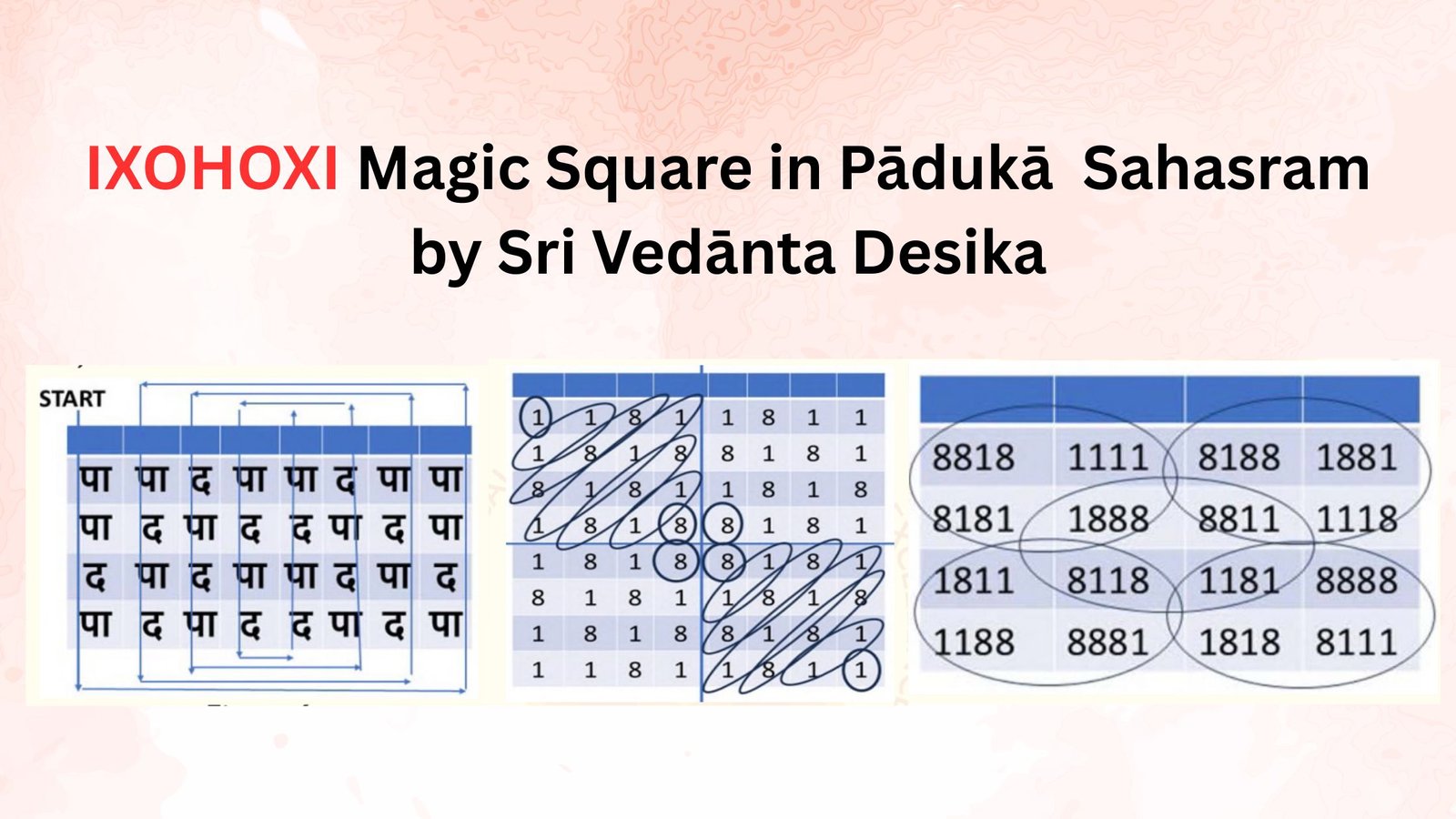
In the above verse only two letters are used and this can be shown in a picture and forms a geometric pattern. The verse actually is to be written along with its mirror image as shown below.
पाापааद पाापाад पаапаа पааद पааद दपаа दпаа ।
दпаа दпаа पааद пааद пааद пааद дпаа дпаа ।।
पааद пааद дпаа дпаа дпаа дпаа पааद पааद ।
पааद पааद дпаа дпаа पаапааद паапааद паапаа ।।
Following is the details about the numerical code used to decode this verse.
Vedic Numerical Code कटपय सङ्ख्या (kaṭapaya saṅkhyā)
In this numerical system:
- The Vyñjanam-consonants beginning with ka (क) and ta (ट) refer to digits from 1 to 9 (i.e. letters from ka (क) to jha (झ) and from ta (ट) to dha (ध) denote 1 to 9.
- Pa (प) to ma (म) stand for 1 to 5.
- Letters from ya (य) and ha (ह) represent the digits 1 to 8.
- The nasal letters nya (ज्ञ) and na (न) denote 0.
- In the case of conjunct consonants, the number denoted only by the last consonant is taken into consideration.
- The vowels following consonants have no value.
- The vowels not preceded by any consonant represent 0.
- The arrangement of the digits is from right to left as per the rule अङ्कानाम् वामतो गति: (aṅkānām vāmato gati:)
- The letter la (ळ) peculiar to the Dravidian languages represent 9.
- The letter ksha (क्ष) denotes 0.
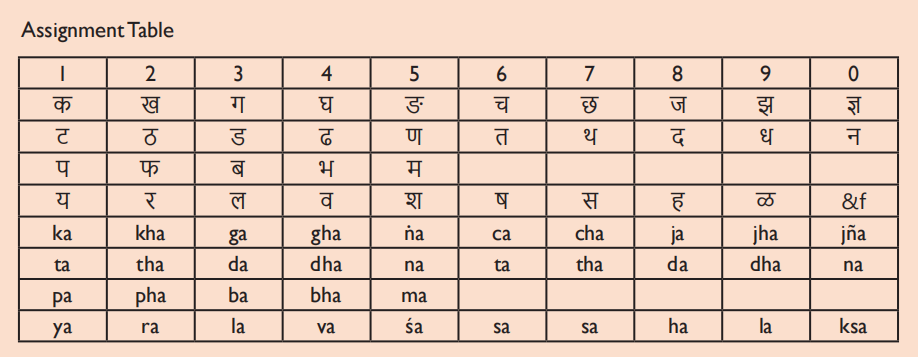
Katapaya Sankhya rule is as follows:
काादि नव टाादि नव पाादि पञ्च यааद्यष्टौ।
kādi nava ṭādi nava pādi pañca yādyaṣṭau |
- काादि नव means ka and the following 8 letters ranging from digits 1 to 9.
- टाादि नव means ta and the following 8 letters ranging from digits 1 to 9.
- पाादि पञ्च means pa and the following 4 letters ranging from digits 1 to 5.
- यааद्यष्टौ means ya and the following 7 letters ranging from digits 1 to 8.
- Ksha is equal to 0.
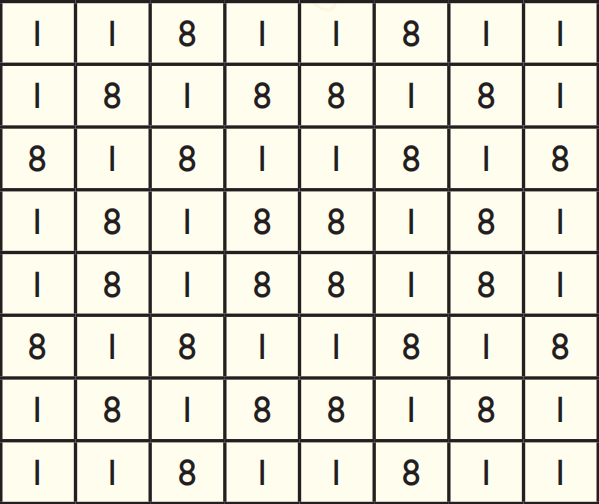
Figure 1
The Findings
From the above 8 x 8 square, one can identify all combinations of digits 1 & 8 and form sixteen 4-digit numbers as follows.
| 1111 | 1811 | 8111 | 8811 |
| 1118 | 1818 | 8118 | 8818 |
| 1181 | 1881 | 8181 | 8881 |
| 1188 | 1888 | 8188 | 8888 |
By scanning the numbers horizontally in Figure 1, following eight 4-digit numbers are identified:
1181, 1811, 8118, 1818, 8188, 1881, 8818 and 8181.
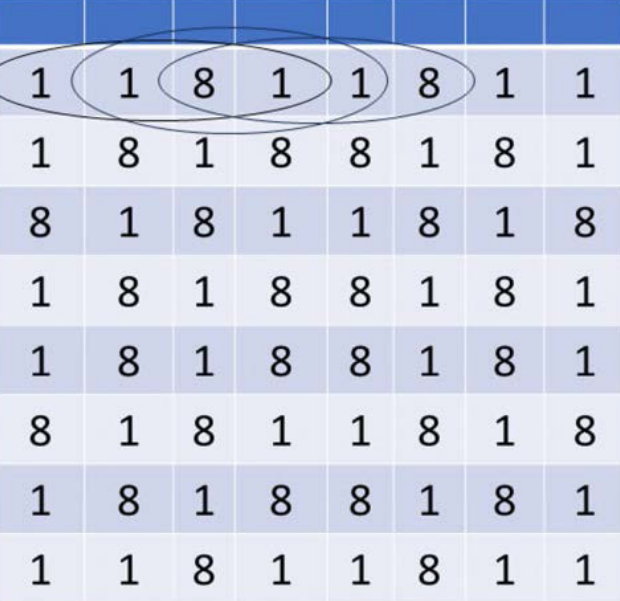
Scanning diagonally, we get the following eight 4-digit numbers:
1111, 1888, 8881, 8811, 1188, 1118, 8111 and 8888.
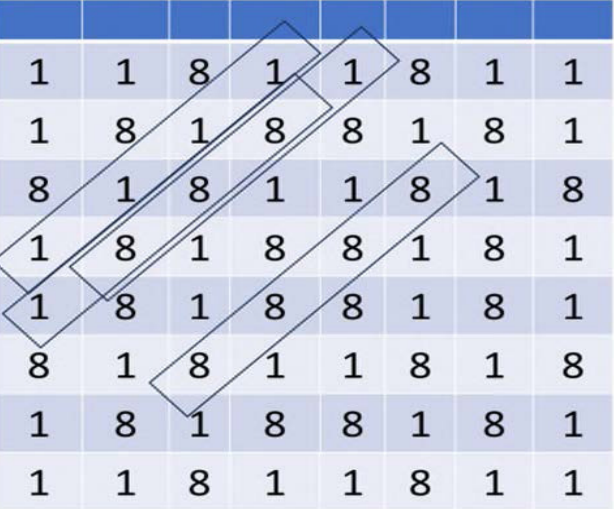
Figure 2
Figure 3
By rearranging all the sixteen 4-digit numbers in a square we get the following table which reveals several mathematical facts bundled inside this beautiful verse in Śrī Pādukā Sahasram.
Result
a. IXOHOXI Magic Square
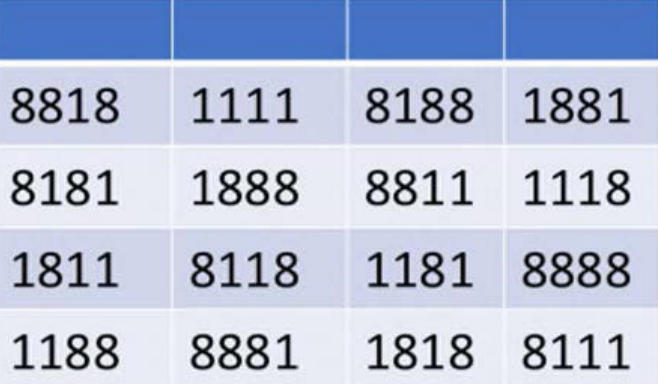
Figure 4 shows how these sixteen numbers form the IXOHOXI magic square. In this magic square total of all numbers in each row, column, diagonal will be 19998.
Figure 4
b. Ramanujan’s Magic Square Pattern
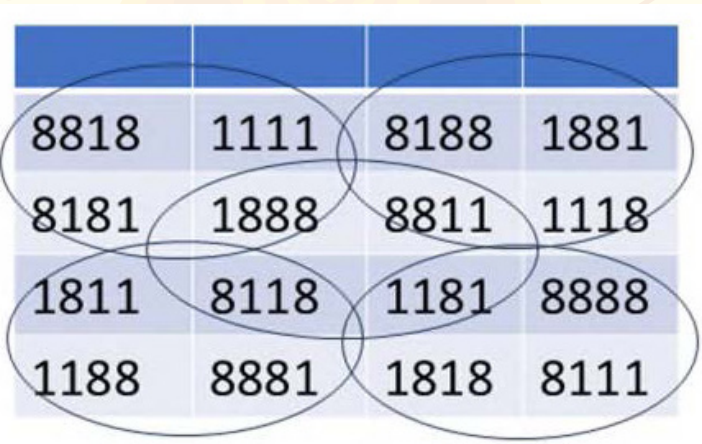
Figure 5 shows just 5 combinations where same total is obtained. In addition to the summation of 4 numbers as shown above, the same total is obtained in the following combinations as well.
- Four corner numbers.
- 4 numbers in second and third row of first two columns and 4 numbers from right two columns of same rows.
- 4 numbers from top and bottom rows of middle two columns and 4 numbers of middle two rows of first and last column.
All these above are showing that the verse follows the pattern of Ramanujan’s magic square.
Figure 5
c. अर्धभ्रमकम् (ardhabhramakam)
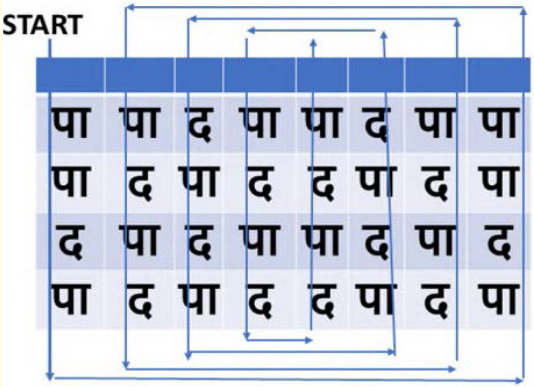
Svāmī Srī Vedānta Deśika, embeds this formation in many of his verses where one can start from top left and go around counter clockwise as shown above and the same verse is formed.
d. Symmetry
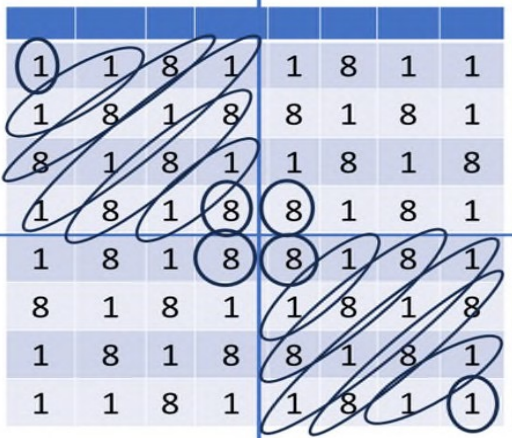
The verse encoded as shown in Figure 2 also forms a beautiful symmetric structure which is shown in Figure 7. The third quadrant is a mirror image of first quadrant and second quadrant is a mirror image of fourth quadrant. Figure 7 shows such a symmetry in quadrants 2 and 4 as an example.
Conclusion
Svāmī Srī Vedānta Deśika is a multi-faceted genius who was described as a Lion among Poets and Logicians, कवि-तार्किक-केसरी (Kavi-Tārkika-Kesarī) and a Sarva-Tantra-Svatantra. This paper shows only one aspect taking an example of just one verse from śrī Pādukā Sahasram.
References
- Srī Pādukā Sahasaram of Srī Vedānta Deśika by The Kuppuswami Sastri Research Institute, Madras, 2017.
- Dr. Balachandra Rao S. Indian Mathematics and Astronomy, Bhavan’s Gandhi Centre of Science & Human Values, Bangalore, 2005.
- The website – www.sadagopan.org
Disclaimer/Publisher’s Note: The statements, opinions and data contained in all publications are solely those of the individual author(s) and contributor(s) and not of SSSUHE and/or the editor(s). SSSUHE and/or the editor(s) disclaim responsibility for any injury to people or property resulting from any ideas, methods, instructions, or products referred to in the content.