Editorial: Juneteenth, Awareness, and Eudaimonia
- Apr 10, 2026
- 288 views

What is Juneteenth?
June 19, 1865 commemorates the day when Major-General Gordon Granger arrived in Galveston, Texas and announced that all Black communities were free citizens and not enslaved anymore. President Abraham Lincoln had issued the Emancipation Proclamation on January 1, 1863 – granting freedom to all slaves across the country – but the Southern States bitterly opposed this law.1 This triggered the American Civil War on April 12, 1861 – fought between those in favor and against the abolition of slavery. It ended after much bloodshed, when General Robert E. Lee surrendered his troops to General Ulysses S. Grant in Virginia on April 9, 18652. Yet the freedom of slaves in the Confederate States was delayed for another two months due to slow information dissemination, intentional suppression, resistance by obstinate slaveholders, and even municipal resistance to obtain free labor for the harvesting season.1,2
One year later, former slaves in Galveston organized the first Juneteenth celebration on June 19, 1866, giving the day its name.¹,² Celebrations of this historic day spread slowly, but had declined by the early 1900s, and were revived in the 1960s by the Civil Rights Movement.3
Despite its popularity, major challenges persisted for integrating Juneteenth into the American societal narrative. Harvard historian Jarvis Givens emphasized that Juneteenth symbolizes both emancipation and incomplete freedom, because many Blacks remained enslaved even up to six years later.4 All historical records were shaped by the white-owned press, so early documentation was biased and fragmentary.¹,⁴ Juneteenth also highlights broader structural inequities, whereby historical injustice was perpetuated for 100 years after the Civil War through housing/schooling segregation, social disadvantages, economic exclusion, political disenfranchisement, and mass incarceration.¹,3,4 Recent reforms have called to dismantle systemic racism, improve retention, and foster equitable access to social, educational, and economic opportunities, as well as to enable future success.
Though Juneteenth finally became a paid federal US holiday in June 2021, but it is currently recognized only in 27 states and Washington DC.5,6 Some critics complain that increasing commercialization may dilute historical meaning, however, many institutions emphasize its importance for self-reflection, community building, and justice.6 Activism by Ms. Opal Lee (the “Grandmother of Juneteenth”) was pivotal in achieving federal recognition and she received the Presidential Medal of Freedom in 2024.6,7 Juneteenth today serves as “Freedom Day”—a symbol of national ideals and the gap between hypocrisy and practice, particularly in Texas.8
The story of Juneteenth—from its delayed awareness to bold commemoration—not only captures the ancient human struggle for freedom and justice, but it also brings us to this issue of the journal.
Why Awareness?
In a Benediction written for this journal, our Founder gently explains how Awareness is Divine.9 He tells us how the taittirīyopaniṣad describes the supreme creative force as – satyam, jñānam, anantam – meaning, the One that exists, is aware of its existence, an eternal existence, without beginning or end. To remove all doubt, He further quotes the aitareyopaniṣad clearly defining Divinity as Awareness – Prajnanam Brahma, boldly declaring that all awareness is Divine. Most naturally, it follows that our ability to be ‘aware’ – of ourselves and of everything around us – is also Divine! Just as the enslaved Black communities lived in inhumane servitude, mortal fear, and abject poverty only because they were not “aware” of their freedom, similarly, we remain unaware of our own Divinity, thereby enslaved by our desires, attachments, emotions, memories, habits, and all other machinations of our minds and bodies! But as our awareness continues to grow, suddenly, unexpectedly, spontaneously, without volition, we become “aware” of our Divinity – and, gaining freedom from all past limitations, our hearts singing with joy and ecstasy – an internal celebration of sorts – we will be ‘free’ like the former slaves on that fateful day in Galveston, Texas!
True to its name, this journal Awareness also seeks, through well-informed discourse, debate, or declaration, to make all serious scholars ‘aware’ of the advances in their respective fields. Those who browse this journal will benefit from its high-quality, transdisciplinary, innovative research in all fields of knowledge, free from financial considerations or commercial interests of any kind, edited and curated by an international set of wellrespected editors, get ideas for making influential advances in human knowledge, and as authors, also receive prompt and fair evaluation of their manuscripts.10
What is Eudaimonia?
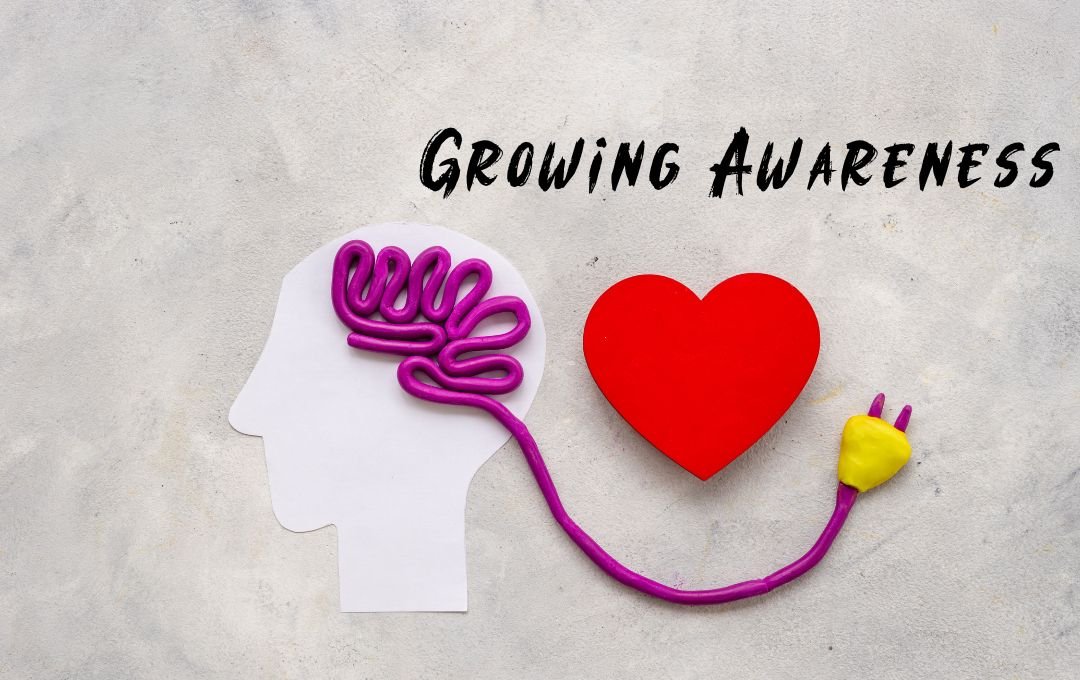
Beyond objective experiences and scholarly pursuits, a growing awareness enables all humans to access the deeply subjective states that give human life a sense of purpose, its innate vibrancy, experiences of beauty, or states of bliss and ecstasy that are fundamental to human flourishing. Aristotle imagined human flourishing in terms of hedonia (experiences of pleasure) and eudaimonia (a life well-lived for the highest good).11,12 Human flourishing essentially involves the flowering of human intelligence into a brilliant intellect, emotional growth leading to kindness and compassion, socialization skills that enhance the richness and depth of all relationships with one other and the environment, and a deep spiritual realization rooted in the intuitive understanding and reverence for life.
This journal issue contains several pointers to achieve the highest levels of human flourishing. An article on The Concept and Model of a Humane Quotient explains the eight universal humane values, namely, Selflessness, Empathy, Integrity, Acceptance, Responsibility, Equity, Diversity, Inclusivity – and synthesizes them in an objective Awareness, Vol 2, Issue 2: Pages 1-4 3 methodology to provide a comprehensive and integrated approach for measuring the ‘humane-ness’ of an individual. Through this measure, a nebulous and often misunderstood concept can manifest a clear pathway for self-transformation and societal good, complete with quantifiable milestones, leading to eudaimonia! Elsewhere, a refreshing poem in the Student’s Corner, titled Where Passion finds Purpose, relates to a similar journey of selfdiscovery and inner transformation.
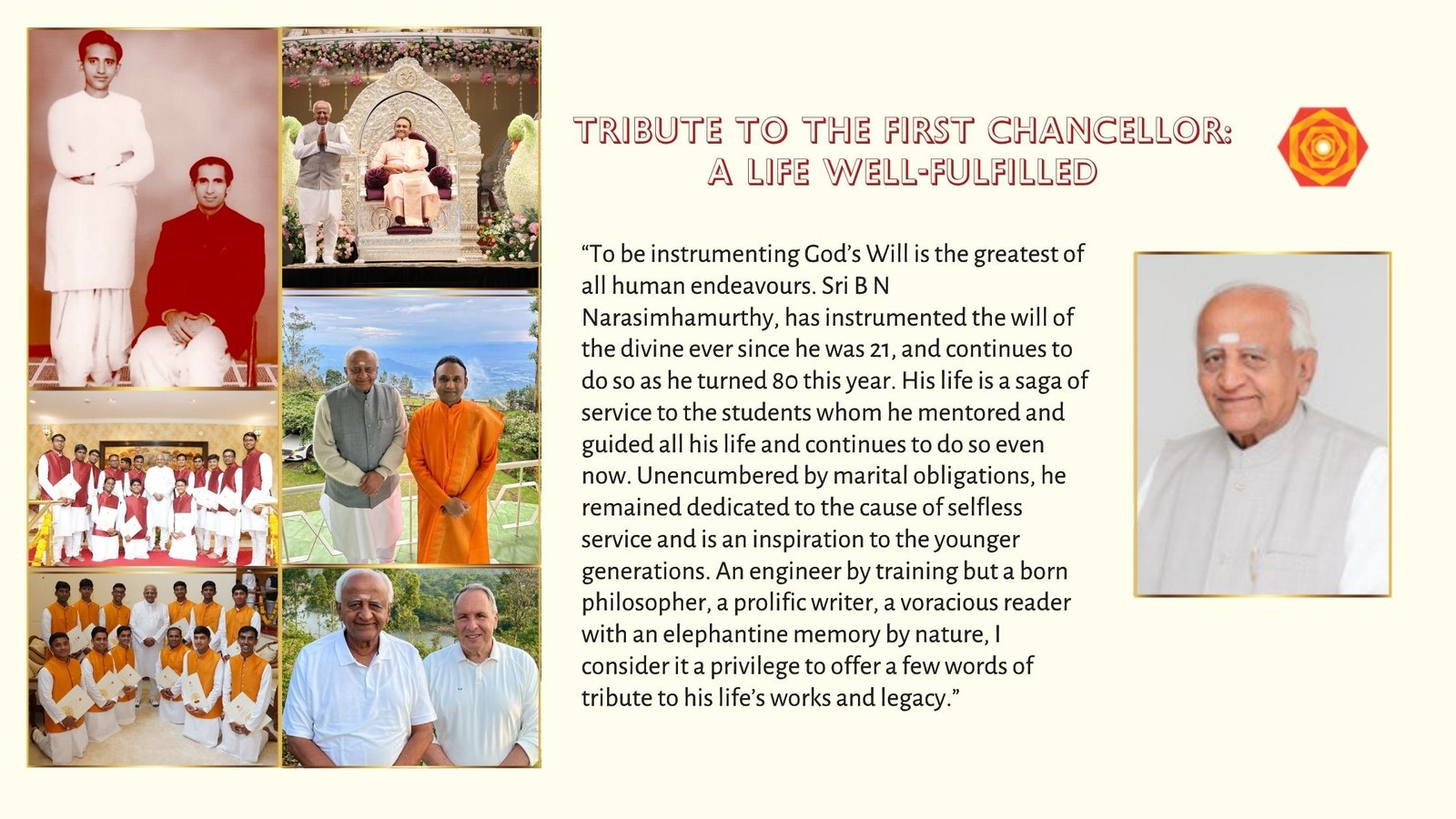
But where this issue finds its unique purpose is by presenting a shining example of eudaimonia – a life well-lived for the highest human good. This illuminatus is none other than the founding Chancellor of the Sri Sathya Sai University for Human Excellence – Shri B. N. Narasimha Murthy! Fondly known as ‘Murthy Anna’ (pronounced “ah-na” meaning ‘brother’), he has served as a glowing beacon of gentle and firm discipline, authoritative knowledge, and selfless service to millions of people and generations after generations of students, teachers, administrators, educationists, governors, and leaders at all levels in many fields. This issue – like Juneteenth – goes from awareness to bold commemoration of one the greatest leaders in education that has ever lived! His life shows incontrovertible evidence of a ‘humane’ awareness, growing into eudaimonia, and realizing the inherent divinity inherent in each of us. We are truly blessed to have witnessed the transformation of such a great soul, instilling an unshakable confidence that each one of us can do it too!
Supplementary Materials: None
Author Contributions: Not applicable.
Funding: None.
Institutional Review Board Statement: Not applicable.
Informed Consent Statement: Not applicable.
Data Availability Statement: Not applicable.
Acknowledgements: The author is intensely grateful to Dr. Shaun Setty for gracious edits and comments.
Conflicts of Interest: None.
References
1. Brown, L. The Story of Juneteenth. JSTOR Daily. June 17, 2016. https://daily.jstor.org/the-story-of-juneteenth/
2. Chang, A. When Did Slavery Really End in the U.S.? The Complicated History of Juneteenth. TIME, June 15, 2023. https://time.com/6286476/juneteenth-when-did-slavery-end/
3. Brown-Nagin T. Juneteenth is a day of reflection of how we as a country and as individuals continue to reckon with slavery. Harvard Law Today. June 18, 2020. https://hls.harvard.edu/today/juneteenth-is-a-dayof-reflection-of-how-we-as-a-country-and-as-individuals-continue-to-reckon-with-slavery/
4. Walsh, B. The Meaning of Juneteenth. Harvard Graduate School of Education News, June 18, 2020. https:// www.gse.harvard.edu/ideas/news/20/06/meaning-juneteenth
5. Boodhoo, N. The Juneteenth milestone. Axios. June 18, 2021.https://www.axios.com/2021/06/18/juneteenthhistory-importance
6. Contreras, R. Juneteenth celebration expands despite civil rights backlash. Axios – Politics & Policy, June 2, 2025. https://www.axios.com/2025/06/02/juneteenth-celebration-civil-rights-backlash Awareness, Vol 2, Issue 2: Pages 1-4 4
7. Gonzalez, C. Biography: Opal Lee (1926). National Women’s History Museum. https://www.womenshistory. org/education-resources/biographies/opal-lee
8. Cobb, J. Juneteenth and the Meaning of Freedom. The New Yorker. June 19, 2020. https://www.newyorker. com/magazine/2020/06/29/juneteenth-and-the-meaning-of-freedom
9. Sri Madhusudhan Sai. Benediction: Praja� nam Brahma - Awareness is Divine. Awareness 1 (1): 24-26. https:// www.awarenessjournals.com/benediction
10. Anand KJS, Setty SP. Striving for Perfection. Awareness 1 (1): 27-29 and https://www.awarenessjournals. com/author-center
11. Kringelbach ML, Vuust P, Deco G. Building a science of human pleasure, meaning making, and flourishing. Neuron 112 (9): 1392-1396. https://doi.org/10.1016/j.neuron.2024.03.022
12. Aristotle (BCE 384-322). Nicomachean Ethics, Book I, Chapter 7 & Book III, Chapter 2. https://www. britannica.com/topic/Nichomachean-Ethics
Disclaimer/Publisher’s Note: The statements, opinions, and data contained in all publications are solely those of the individual author(s) and do not necessarily reflect those of the publisher or editors. They disclaim responsibility for any consequences arising from the use of the content.